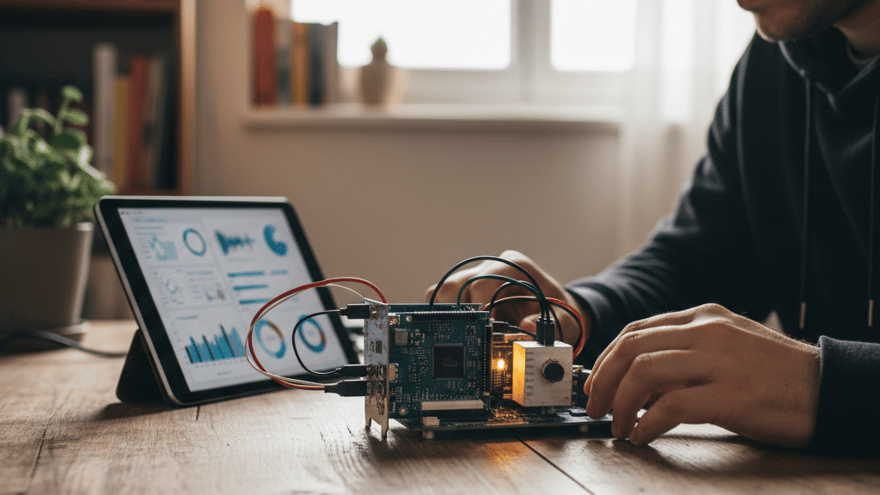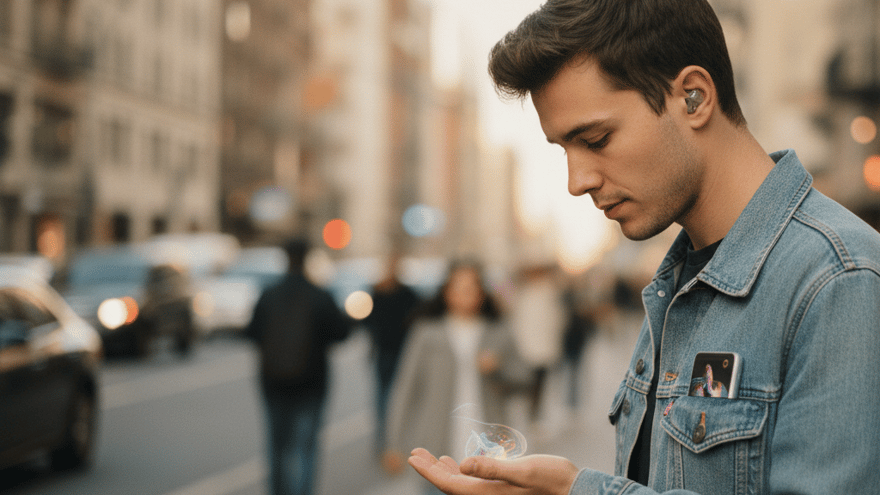
Seu agente IA vive no bolso (wearable, always-on, context-aware)
Agente IA wearable (pendant, smartwatch). Always-on, context-aware (location, pessoas, hora). Meta aposta nisso.

Equipe OpenClaw · Time de Engenharia & Produto
A Equipe OpenClaw é formada por engenheiros, designers e especialistas em IA dedicados a construir a melhor plataforma de agentes conversacionais para negócios brasileiros. Combinamos expertise…
Seu agente IA vive no bolso (wearable, always-on, context-aware)
Você tem SaaS.
Seu SaaS: agente IA (atendimento ao cliente, automação).
Você pensa:
"Agente IA vive na cloud (server-based).
Clientes acessam via web (browser).
Clientes acessam via mobile app (iOS, Android).
Agente só responde quando customer inicia conversation (reactive).
Customer must open app, type question, wait for response.
Usage is sporadic (customer uses when needed, then forgets).
Engagement is low (agente is invisible, background).
But: What if agente could live on wearable? (pendant, smartwatch, earbuds).
What if agente was always accessible? (on customer's body, always-on).
What if agente knew context? (location, who's nearby, time of day).
Engagement would explode (agente becomes indispensable).
But: Is that possible? Realistic? Worth investing?"
Then:
You read about Meta:
"Meta is developing AI pendant.
"Pendant is wearable device (worn on body, like jewelry).
"Always-on (runs 24/7, not just when user opens app).
"AI-powered (has AI assistant built-in, personal assistant).
"Contextual (knows location, nearby people, time, calendar).
"Implication: Wearable AI changes engagement model (user doesn't open app, app is always with user)."
You realize:
"Wait, Meta is betting big on wearable AI.
Meta sees future: AI on body (not in cloud).
Meta sees trend: Always-on assistant (not reactive).
Meta sees value: Context-aware (knows location, people, time).
If Meta is investing billions in this, it must work.
What does this mean for my agente IA?
Should I build wearable version?
How do I compete (if Meta dominates wearable)?
When does this change my business model?"
O problema (agente IA é desktop/mobile, não wearable)
Why browser/app-based agente is limited
TRADITIONAL AGENTE (desktop/mobile app-based):
Access model:
- Customer must open browser (or app)
- Customer must navigate to agente (find URL, or tap icon)
- Customer must type question (or voice)
- Customer must wait for response (latency)
- Customer closes browser (forgets about agente)
Engagement:
- Usage is reactive (customer initiates)
- Usage is sparse (customer remembers to use)
- Usage is interrupted (context lost between sessions)
- Agente is background (not in customer's attention)
- Value is low (customer uses occasionally)
EXAMPLE: TRADITIONAL AGENTE USAGE
Customer journey:
-
Morning: Customer at coffee shop. Question comes up ("what's my account balance?").
- Must: Open phone, find app, open app, navigate to agente, ask question.
- Reality: "Eh, I'll check later" (uses nothing).
-
Afternoon: At office. Question about product features.
- Must: Interrupt work, open browser, type question.
- Reality: "Too busy, I'll handle it myself" (uses nothing).
-
Evening: At home. Scrolling phone. Remembers question.
- Now: Opens app, asks agente.
- Response time: 2-3 seconds (feels slow).
- Value: Got answer, but hours late (not useful for real-time decisions).
Result:
- Usage is low (customer forgets, doesn't prioritize)
- Engagement is low (customer doesn't check regularly)
- Value is low (answers come too late for decisions)
- Churn risk is high (customer says "agente isn't useful")
WHY BROWSER/APP AGENTE FAILS:
-
Friction (customer must open app)
- Requires: Phone unlock + app search + app load + navigation = 30 seconds
- Barrier: Too much effort for quick question
- Result: Customer skips agente (uses Google instead)
-
Context loss (question asked in isolation)
- Browser: Customer types question, gets answer, closes browser
- Next day: Customer forgot context, must re-ask
- Result: Repeated questions, low efficiency
-
Timing miss (answer comes too late)
- Customer: "I need answer in 5 minutes (real-time decision needed)"
- App agente: "I'll answer when you open app (1 hour later)"
- Result: Answer comes too late (useless for decision-making)
-
Engagement valley (customer forgets agente exists)
- Week 1: Customer tries agente (novelty)
- Week 2: Customer uses occasionally
- Week 3: Customer forgets agente exists
- Month 1: Customer churns ("agente wasn't useful")
- Result: Low LTV, high churn
-
Competition (user attention is scarce)
- Phone has 100+ apps (customer scrolls past yours)
- Browser has 1000+ websites (customer finds alternative)
- Result: Agente is ignored (buried in noise)
A solução (wearable agente, always-on, context-aware)
Strategy: Move agente from app → wearable (body-worn device)
WEARABLE AGENTE (Meta AI pendant model):
Access model:
- Agente is always with customer (worn on body)
- Agente is always listening (always-on, low power)
- Customer can ask anytime (without opening app)
- Agente responds instantly (in-ear audio, haptic feedback)
- Agente remembers context (continuous conversation, not sessions)
Engagement:
- Usage is proactive (agente suggests answers before customer asks)
- Usage is continuous (agente is always accessible)
- Usage is contextual (agente knows location, situation, time)
- Agente is foreground (customer hears/feels agente responses)
- Value is high (agente is indispensable, can't live without it)
EXAMPLE: WEARABLE AGENTE USAGE
Customer journey:
-
Morning: Customer at coffee shop. Question comes up.
- Wearable: Hears prompt in earbuds ("Your account balance is R$ 5,000")
- Reality: Got answer instantly (no friction)
- Value: High (real-time answer, helpful)
-
Afternoon: At office. Customer near product expertise colleague.
- Wearable: Detects location (office), detects nearby people (colleague is product expert)
- Wearable: Proactively suggests ("John is nearby, ask him about features")
- Reality: Customer gets suggestion (before asking)
- Value: Very high (agente predicts needs)
-
Evening: Walking in city. Trying to decide where to eat.
- Wearable: Knows location (downtown), knows time (7pm), knows preferences (customer's history)
- Wearable: Suggests restaurants ("Based on your location + time + preferences, try X")
- Reality: Customer gets curated suggestion (perfectly timed)
- Value: Exceptional (agente becomes personal assistant)
Result:
- Usage is high (customer wears device 24/7)
- Engagement is high (customer interacts multiple times per day)
- Value is high (answers are timely, contextual, proactive)
- Churn risk is low (customer can't live without wearable)
WHY WEARABLE AGENTE WINS:
-
Zero friction (always accessible, no app needed)
- Requires: Say question out loud (1 second)
- Barrier: None (always with customer)
- Result: Customer uses agente constantly
-
Context continuity (agente remembers previous conversations)
- Wearable: "When you asked yesterday, you said X. Now I understand your question better."
- Result: Smarter answers (agente learns)
-
Perfect timing (agente knows when customer needs answer)
- Wearable: Detects customer is at restaurant, suggests menu items
- Result: Answer comes at right time (useful for decision)
-
Engagement explosion (customer can't live without device)
- Week 1: Customer tries wearable (novelty + utility)
- Week 2: Customer relies on wearable (indispensable)
- Month 1: Customer is addicted (uses 20+ times/day)
- Year 1: Customer pays premium (can't switch away)
- Result: High LTV, low churn, strong network effects
-
Network effects (wearable knows network)
- Wearable: Detects nearby people (Bluetooth, WiFi)
- Wearable: Knows their profiles (LinkedIn, social media)
- Wearable: Recommends connections ("John is nearby, he knows about X")
- Result: Social features emerge (agente becomes social platform)
Option 1: Ship wearable version (hardware)
SETUP: Build hardware (pendant, earbuds, smartwatch band)
Approach:
- Partner with hardware manufacturer (e.g., Samsung, Apple, Chinese OEM)
- Design wearable device (small, lightweight, always-on)
- Embed LLM locally (or stream from cloud)
- Add sensors (microphone, speaker, location, proximity)
- Ship as SKU (customers buy device + SaaS subscription)
Benefit:
- Hardware lock-in (customer owns device, uses your SaaS)
- Context awareness (sensors detect location, people, time)
- Always-on engagement (device is always with customer)
- Premium pricing (hardware + SaaS = higher margins)
Challenge:
- R&D cost: R$ 5-10M (hardware development)
- Manufacturing: R$ 2-5M (tooling, first production run)
- Supply chain: Complex (manufacturing, logistics, returns)
- Regulatory: FCC, CE, other certifications
- Time to market: 2-3 years (hardware cycle)
When to do:
- You have product-market fit (SaaS is working)
- You have funding (R$ 20M+)
- You want to become hardware company (long-term)
- You see path to profitability (premium pricing covers R&D)
Example:
- Meta is building AI pendant (Meta has R&D resources)
- Apple shipped Vision Pro (Apple has hardware expertise)
- Your startup: Partner with OEM (you design software, they build hardware)
Option 2: Wearable-ready software (software-first)
SETUP: Build software that works on existing wearables
Approach:
- Optimize agente for smartwatches (Apple Watch, Wear OS)
- Optimize agente for earbuds (AirPods, Galaxy Buds)
- Optimize agente for fitness trackers (Fitbit, Oura)
- Use existing sensors (already in devices)
- Sync with customer's phone (cloud-based context)
Benefit:
- No hardware cost (use existing devices)
- Fast time-to-market (months, not years)
- Low R&D cost (R$ 500k-2M)
- Access to millions of existing devices
- Freemium model (free on smartwatch, premium features paid)
Challenge:
- Limited sensor access (wearable OS restricts permissions)
- Limited compute (can't run large LLM locally, must use cloud)
- Fragmentation (Apple Watch ≠ Wear OS ≠ FitOS)
- Competition (Apple has Siri, Google has Assistant, built-in)
- Discoverability (app stores have millions of apps)
When to do:
- You want to move fast (software-first)
- You have limited budget (R$ 2-5M)
- You want to validate demand first (before hardware investment)
- You want to serve existing users (not sell devices)
Example:
- Slack started on web, added mobile (web-first)
- Then added smartwatch integration (reaction, status)
- Your startup: Start with smartwatch app (MVP), validate demand, then consider hardware
Option 3: Hybrid approach (software + partner hardware)
SETUP: Build software, partner with hardware manufacturer
Approach:
- Build wearable-optimized software (smartwatch, earbuds, fitness tracker)
- Partner with device manufacturer ("Bring your agente to our devices")
- Co-market (manufacturer promotes agente, you promote device)
- Revenue share (split subscription revenue)
- Exclusive partnerships (e.g., exclusive on Apple Watch)
Benefit:
- Fast time-to-market (use partner's hardware)
- Lower cost (no hardware R&D)
- Wide distribution (partner's customer base)
- Premium partnerships (exclusive positioning)
- Scalable (partner handles hardware, you handle software)
Challenge:
- Partnership complexity (negotiating terms)
- Revenue split (partner takes cut)
- Dependency (partner could launch competing product)
- Discoverability (still buried in app store)
When to do:
- You have software working (smartwatch app MVP)
- You have customer demand (people want wearable version)
- You have credible software (partner wants to work with you)
- You want to scale (use partner's distribution)
Example:
- Zoom partnered with smartwatch OEMs (Zoom on Apple Watch)
- Your startup: Partner with Samsung (agente on Galaxy Watch), Apple (agente on Apple Watch)
Conclusão: Wearable agente is the future (always-on, context-aware, indispensable)
**O que você precisa saber:
-
Browser/app agente has friction (customer must open app)
- Usage: Sporadic (customer forgets, doesn't prioritize)
- Engagement: Low (customer uses occasionally)
- Value: Low (answers come too late, out of context)
- Churn: High (customer says "agente isn't useful")
- Lesson: App agente is background (invisible, forgettable)
-
Meta is betting billions on wearable AI (pendants, earbuds, smartwatches)
- Insight: Wearable is form factor of future (not phones)
- Strategy: Always-on assistant (24/7 accessible)
- Value: Context-aware (knows location, people, time)
- Engagement: Explosion (customer uses 20+ times/day)
- Lesson: Meta sees wearable as next platform (after mobile)
-
Wearable agente eliminates friction (always with customer)
- Access: Instant (ask out loud, get answer in 1 second)
- Engagement: Continuous (device is always-on)
- Value: Contextual (agente predicts needs)
- Usage: Explosive (customer can't live without it)
- Lesson: Zero friction = high engagement
-
Context awareness is the killer feature (location, people, time)
- Wearable knows: Where customer is (GPS, WiFi)
- Wearable knows: Who's nearby (Bluetooth, WiFi, calendar)
- Wearable knows: Time of day (morning, evening)
- Wearable knows: Calendar (meetings, events, free time)
- Result: Proactive suggestions (agente predicts before customer asks)
- Lesson: Context = personalization on steroids
-
Wearable changes business model (hardware lock-in)
- App model: Customer can uninstall (low switching cost)
- Wearable model: Customer owns device (high switching cost)
- Result: Better retention, premium pricing possible
- Example: Apple Watch owners → stuck with Apple ecosystem (high LTV)
- Lesson: Hardware is moat (customer is locked in)
-
You don't need to build hardware (software-first is viable)
- Strategy 1: Build on existing wearables (smartwatch app)
- Strategy 2: Partner with hardware OEM (co-branded device)
- Strategy 3: Hybrid (software + licensing to hardware partners)
- Result: Reach millions of users without R&D cost
- Lesson: Software-first wearable is faster + cheaper than hardware
Na OpenClaw, ajudamos SaaS a:
- ASSESS agente distribution (app-only vs. wearable-ready)
- PLAN wearable strategy (smartwatch MVP, earbuds, fitness tracker)
- BUILD wearable software (optimized for small screens, voice, haptics)
- INTEGRATE context awareness (location, proximity, calendar)
- PARTNER with hardware makers (or build own hardware)
- SCALE wearable engagement (always-on, context-driven)
Resultado: Seu agente IA é WEARABLE (sempre com customer) + CONTEXT-AWARE (sabe localização, pessoas, hora) + PROACTIVE (sugere antes de customer perguntar) + INDISPENSABLE (customer não consegue viver sem) + PREMIUM-PRICED (hardware lock-in = better margins).
Seu agente vive em app (customer abre quando lembra)?
Ou você já passou pra wearable (pendant, smartwatch, always-on)?
Publicado em 31 de maio de 2026