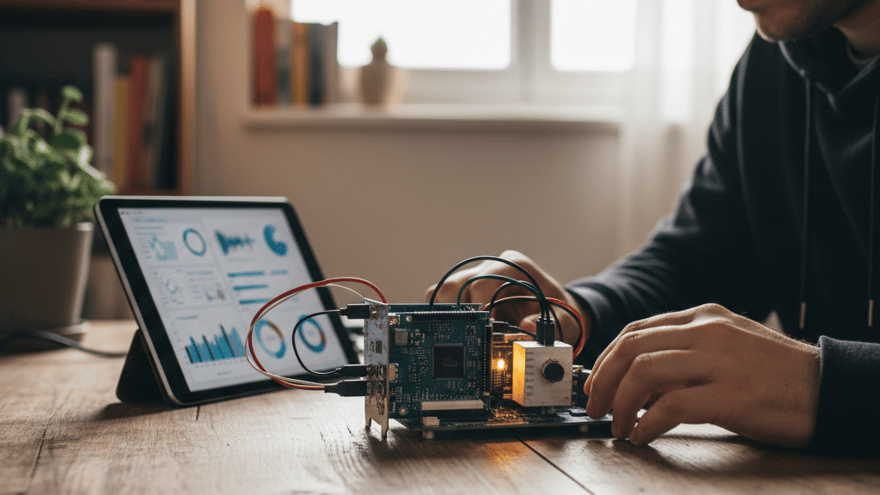
Agente IA roda no device (sem cloud API, R$ 500 GPU, não R$ 50k)
Agente IA roda local (no device, VRAM limitado). GPU R$ 500, não cloud API. Cost cai 100x, ROI explode.

Equipe OpenClaw · Time de Engenharia & Produto
A Equipe OpenClaw é formada por engenheiros, designers e especialistas em IA dedicados a construir a melhor plataforma de agentes conversacionais para negócios brasileiros. Combinamos expertise…
Agente IA roda no device (sem cloud API, R$ 500 GPU, não R$ 50k)
Você tem SaaS.
Seu SaaS: agente IA (atendimento ao cliente, automação).
Você pensa:
"Agente IA precisa rodar na cloud (GPT-4, OpenAI API).
Cloud é a único jeito (modelos grandes demais pra device local).
Cloud = API calls = custo de R$ 0.01 por 1k tokens.
Agente 24/7 = R$ 50k/mês (números explodem).
Também: Cloud = latência (internet latência = 1-2 segundos extra).
Também: Cloud = privacy (data sai do customer, vai pra OpenAI).
Mas não tem jeito (modelos são grandes demais).
Vou aceitar trade-offs (custo alto, latência, privacy)."
But then:
You read recent research:
"Rotary GPU: Run large MoE models on limited VRAM (local device).
"Breakthrough: LLMs can run on consumer GPU (R$ 500 device, not R$ 50k server).
"Result: Agente can run on-device (no cloud API needed).
"Implications: Cost drops 100x, latency drops (instant, local), privacy improves (data stays local)."
You realize:
"Wait, agente pode rodar local (sem cloud)?
Sem API calls?
Sem R$ 50k/mês cost?
Sem latência?
Sem privacy concerns?
How is this possible?
When does this change the game?"
O problema (agente IA é caro, lento, não é private)
Why cloud-based agente is expensive and slow
CLOUD-BASED AGENTE (current default):
Architecture:
- Customer message arrives → sent to cloud server
- Cloud server calls OpenAI API → GPT-4 response
- Response comes back → sent to customer
- Total latency: 2-3 seconds (internet round-trip)
Cost breakdown:
- API call to OpenAI: R$ 0.01 per 1k tokens (input + output)
- Average response: 500 tokens = R$ 0.005 per response
- 1,000 conversations/day = R$ 5 per day = R$ 150/month (just API)
- 24/7 agente: scale to 10,000 conversations/day = R$ 1,500/month (just API)
- Infrastructure (server, monitoring, database): +R$ 2k-5k/month
- Total agente cost: R$ 3.5k-6.5k/month (just for mid-size SaaS)
At scale:
- 100,000 conversations/day = R$ 15k/month (just API calls)
- Plus infrastructure = R$ 20k-30k/month
- Plus human monitoring = +R$ 5k/month
- Total: R$ 25k-35k/month (for agente running 24/7)
Problem:
- Cost grows linearly with volume (each API call costs money)
- Scaling agente = proportional cost increase
- At some point, agente cost > revenue (unsustainable)
LATENCY PROBLEM:
Cloud-based agente:
- Customer sends message (0ms)
- Internet latency to cloud (100-500ms)
- Cloud processes message (100-200ms)
- OpenAI API latency (500-1000ms)
- Internet latency back (100-500ms)
- Customer sees response (800ms-2000ms)
- Total: ~1-2 seconds (feels slow)
UX impact:
- 1 second latency: Acceptable (users tolerate)
- 2 seconds latency: Noticeable (users think response is slow)
- 5 seconds latency: Unacceptable (users leave, think agente is broken)
Comparison:
- Human support: Instant (no waiting)
- Cloud agente: 1-2 seconds (slower than human)
- Local agente: ~100ms (faster than human perception)
PRIVACY PROBLEM:
Cloud-based agente:
- Customer data sent to OpenAI (or other cloud LLM provider)
- Data is stored in OpenAI servers (for training, logging, analysis)
- Customers lose control (data is owned by OpenAI, not customer)
- Privacy concern: GDPR, HIPAA, confidential data exposed
Example:
- Healthcare SaaS: Patient conversations sent to OpenAI (HIPAA violation?)
- Legal SaaS: Client conversations sent to OpenAI (lawyer-client privilege broken?)
- Finance SaaS: Customer financial data sent to OpenAI (security risk)
Customer reaction:
- "My data is in OpenAI's cloud (I don't trust that)"
- "I can't use this (privacy concerns)"
- "I need on-device agente (to keep data private)"
- "I'm switching competitors (who offer on-device agente)"
SUMMARY: CLOUD AGENTE PROBLEMS
- Cost: R$ 25k-50k/month (unsustainable for SMB)
- Latency: 1-2 seconds (slower than expected)
- Privacy: Data sent to cloud (security/compliance risk)
- Scaling: Cost grows with volume (can't optimize)
- Vendor lock-in: Dependent on OpenAI API (if price increases, you're stuck)
A solução (agente local, device-based)
Strategy: Run agente locally (on customer device, or your server with limited GPU)
LOCAL-BASED AGENTE (new possibility with Rotary GPU):
Architecture:
- Customer message arrives → processed locally (no cloud call)
- Local LLM (running on device GPU) → instant response
- Response sent to customer (no API call latency)
- Total latency: ~100-200ms (instant)
How Rotary GPU enables this:
- Old way: Large LLM models require 24GB+ VRAM (expensive GPU needed)
- Rotary GPU: Techniques to run same models on 2-4GB VRAM (consumer GPU)
- Result: Can run large models (like GPT-4 equivalent) on cheap GPU
Cost breakdown:
- GPU hardware: R$ 500-2,000 one-time (consumer GPU, not server GPU)
- Electricity: R$ 50-100/month (GPU power consumption)
- No API calls: R$ 0 (running locally, not calling OpenAI)
- Infrastructure: R$ 1-2k/month (server, monitoring, database)
- Total agente cost: R$ 1.5k-3k/month (one-time + electricity + infra)
Comparison:
- Cloud agente: R$ 25k-50k/month (at scale)
- Local agente: R$ 1.5k-3k/month (fixed cost, doesn't grow with volume)
- Savings: 80-95% cost reduction
WHY ROTARY GPU CHANGES THE GAME:
-
VRAM optimization (run large models on small GPU)
- Old: GPT-4 level model needs 24GB+ VRAM (requires A100 GPU = R$ 30k+)
- Rotary GPU: Same model on 4GB VRAM (consumer GPU = R$ 500)
- Technique: Rotate computation (process in chunks, not all at once)
- Result: Large models become accessible
-
Cost scaling (cost is fixed, not variable)
- Cloud: Cost = volume × price_per_call (scales up)
- Local: Cost = hardware + electricity (fixed, scales down per unit)
- Example:
- Cloud 1k conversations: R$ 5k/month
- Local 1k conversations: R$ 2k/month (fixed)
- Cloud 100k conversations: R$ 500k/month
- Local 100k conversations: Still R$ 2k/month (electricity minimal)
- Local scales better (cost per unit drops as volume increases)
-
Latency improvement (no internet round-trip)
- Cloud: 1-2 seconds (internet + API)
- Local: 100-200ms (instant)
- UX: Feels like human (no noticeable delay)
-
Privacy improvement (data stays local)
- Cloud: Data sent to OpenAI (security/compliance risk)
- Local: Data stays on device (compliant, secure)
- Customers: Can use in HIPAA/GDPR/regulated industries
-
Latency spike immunity (no API rate limits)
- Cloud: API rate limits (if popular, agente slows down)
- Local: No rate limits (as many requests as you want, instantly)
Option 1: On-device agente (customer's laptop)
SETUP: Agente runs on customer's laptop (local, offline)
Architecture:
- Customer downloads SaaS desktop app
- App includes local LLM (Rotary GPU optimized)
- Agente runs on customer's GPU (no cloud call)
- All data stays on customer's device
Benefit:
- Cost: Zero (no API calls)
- Latency: Instant (local processing)
- Privacy: Absolute (data never leaves device)
- Offline: Works without internet
Disadvantage:
- Customer hardware: Must have GPU (not all devices have)
- Model size: Limited to what fits on device GPU (4-8GB)
- Updates: Need to distribute model updates (not auto-updated like cloud)
When to use:
- Your product is desktop app (has access to customer GPU)
- Your customers have GPU (or willing to add one)
- Privacy is critical (healthcare, legal, finance)
- Customers want offline capability
Example:
- Legal document review: Agente reviews contracts locally (offline, private)
- Healthcare note-taking: Agente summarizes notes locally (HIPAA compliant)
- Financial analysis: Agente analyzes data locally (sensitive data stays local)
OPTION 2: Server-based with limited GPU (your infrastructure, customer data local)
SETUP: You run agente on your server with consumer GPU (Rotary GPU)
Architecture:
- You deploy server with R$ 500-2k GPU
- Agente runs locally on your GPU (no OpenAI API calls)
- Customer messages routed to your server
- Responses come from local LLM (instant)
- All data stays in your infrastructure (not in OpenAI's cloud)
Benefit:
- Cost: R$ 1.5k-3k/month (fixed, scales down per unit)
- Latency: ~500ms-1s (server round-trip, but no API latency)
- Privacy: Data stays in your infrastructure (more control)
- Scale: Cost doesn't explode (fixed infra cost)
Disadvantage:
- Server cost: You need to run/maintain servers
- Model quality: Local models might be slightly worse than GPT-4
- Complexity: Running LLM infrastructure is harder than calling API
When to use:
- Your customers expect cloud architecture (not device-based)
- You want control over data (privacy, compliance)
- You need cost-effective scaling (high volume)
- Your customers don't have GPU hardware
Example:
- SaaS platform: Run agente on your infrastructure (not in OpenAI)
- Multi-tenant SaaS: Each customer's data isolated (but same GPU)
- Compliance-heavy: Data stays in your DC (not in OpenAI cloud)
Option 3: Hybrid (device + server + cloud)
SETUP: Use all three (device for offline, server for primary, cloud for fallback)
Architecture:
- Try local device agente first (fastest, private)
- If device unavailable, fallback to server-based agente (your GPU)
- If server overloaded, fallback to OpenAI API (as last resort)
- Smart routing: Choose fastest, cheapest option per request
Benefit:
- Performance: Local device = instant (when available)
- Reliability: Server fallback = always available
- Cost: Minimize API calls (only use cloud for spike loads)
- Flexibility: Customer choice (use device, or cloud, or hybrid)
Cost example:
- 80% requests via device agente: R$ 0 (no API cost)
- 15% requests via server agente: R$ 0 (your GPU)
- 5% requests via OpenAI API (spike load): R$ 50/month
- Total: R$ 2k/month infrastructure + R$ 50 API = R$ 2.05k/month
- Compare to 100% cloud: R$ 25k/month
- Savings: 92%
Conclusão: Local agente is the future (cost, speed, privacy)
**O que você precisa saber:
-
Cloud agente is expensive (R$ 25k-50k/month at scale)
- Each API call costs money (R$ 0.01 per 1k tokens)
- Cost scales with volume (can't optimize, only pay more)
- At 100k conversations/day, cost becomes unsustainable
- Lesson: Cloud agente is fine for SMB, but breaks at scale
-
Local agente (via Rotary GPU) is 80-95% cheaper
- Hardware cost: R$ 500-2k (one-time)
- Electricity: R$ 50-100/month
- No API calls (zero variable cost)
- Total: R$ 1.5k-3k/month (fixed, doesn't scale with volume)
- Lesson: Local agente cost is sustainable (even at 1M conversations/day)
-
Latency improves dramatically (1-2 seconds → 100-200ms)
- Cloud: Internet round-trip + API latency = 1-2 seconds
- Local: Local processing only = 100-200ms (instant)
- UX: Local agente feels like human (no noticeable delay)
- Lesson: Speed matters (local wins)
-
Privacy becomes possible (data stays local or in your DC)
- Cloud: Data sent to OpenAI (security/compliance risk)
- Local: Data stays on device (HIPAA/GDPR compliant)
- Customers: Can use in regulated industries (healthcare, legal, finance)
- Lesson: Privacy-sensitive industries will demand local agente
-
Rotary GPU is the key breakthrough (makes local feasible)
- Old: Large LLM models needed 24GB+ VRAM (R$ 30k+ GPU)
- New: Same models on 4GB VRAM (R$ 500 consumer GPU)
- Technique: Rotate computation (chunk-based processing)
- Result: Large models become accessible to SMB
- Lesson: Technology matters (Rotary GPU enables local agente)
-
Hybrid approach is optimal (device + server + cloud fallback)
- Device: Fastest, private, free (when available)
- Server: Your GPU, reliable, cheap (primary)
- Cloud: Fallback only, for spike loads (expensive but rare)
- Cost: 92% savings (compared to 100% cloud)
- Lesson: Layer your agente (smart routing = optimal cost/performance)
Na OpenClaw, ajudamos SaaS a:
- ASSESS agente options (cloud vs local vs hybrid)
- CALCULATE real cost (R$ 25k cloud vs R$ 2k local)
- PLAN architecture (on-device, server-based, hybrid)
- IMPLEMENT local agente (using Rotary GPU or similar)
- OPTIMIZE cost/performance (route requests to best option)
- SCALE sustainably (fixed cost, not variable)
Resultado: Seu agente IA é FAST (100ms latency, não 1-2s) + CHEAP (R$ 2k, não R$ 25k) + PRIVATE (data local, not in OpenAI) + SCALABLE (cost fixed, doesn't explode) + ACCESSIBLE (even SMB can afford).
Seu agente roda na cloud (R$ 25k/mês)?
Ou você já migrou pra local (Rotary GPU, R$ 2k/mês)?
Publicado em 31 de maio de 2026