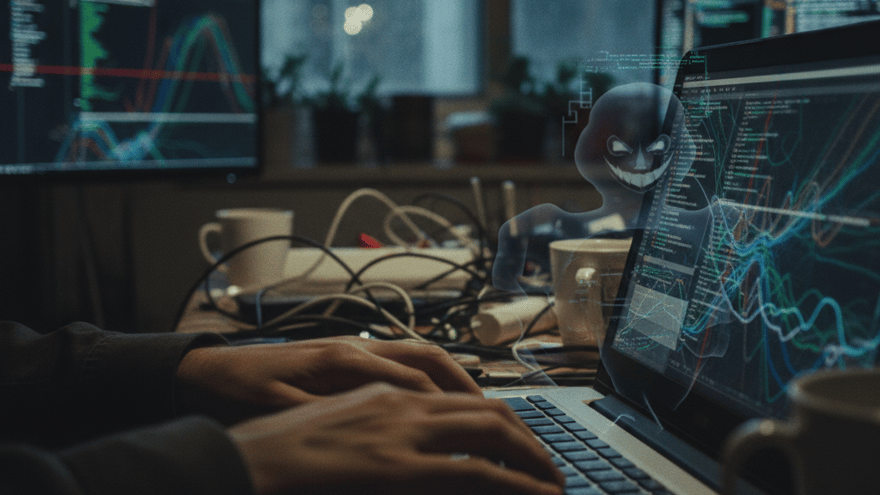
Agente IA local (on-device) muda tudo (custo, latência, privacidade)
Agente IA roda local (no PC, não na cloud). Cost cai (sem API). Latência cai (instant). Privacy melhora.

Equipe OpenClaw · Time de Engenharia & Produto
A Equipe OpenClaw é formada por engenheiros, designers e especialistas em IA dedicados a construir a melhor plataforma de agentes conversacionais para negócios brasileiros. Combinamos expertise…
Agente IA local (on-device) muda tudo (custo, latência, privacidade)
Você tem SaaS.
Seu SaaS: agente IA (atendimento ao cliente, automação).
Você escolheu arquitetura:
"Agente roda na cloud (meu servidor ou OpenAI API).
Cliente envia mensagem (pra meu servidor).
Meu servidor chama API (OpenAI, Anthropic).
API retorna resposta (em ~1-2 segundos).
Cliente vê resposta (em ~2-3 segundos total, internet latência).
Custo: R$ 0.01 por API call (OpenAI).
Privacy: Data sai do customer (vai pra OpenAI cloud).
Mas funciona (agente está em produção)."
You think:
"Cloud API é o padrão (todo mundo usa).
Cloud API é confiável (OpenAI é mature).
Cloud API é escalável (pagpor uso).
Não preciso pensar em alternativas (cloud é default)."
But then:
You read recent news:
"Microsoft + Nvidia (building AI PCs).
"Feature: AI agents run LOCAL (on the PC, not cloud).
"Implication: Agente pode rodar on-device (sem API calls).
"Question: Should I reconsider cloud-only architecture?"
You realize:
"Wait.
Agente pode rodar local (no PC do customer)?
Sem chamar API (meu servidor não precisa)?
Sem enviar data (privacidade total)?
Sem latência (instant response)?
Sem custo (sem API calls)?
Mas como?
E quando isso é melhor que cloud?
E quando não é?"
O problema (cloud-only agente = custo alto, latência alta, privacy baixa)
Current architecture (cloud-based agents)
CURRENT FLOW (Cloud-based agent):
Customer types: "Qual é o preço?" ↓ Message sent to your server (internet latency: ~50ms) ↓ Your server receives message ↓ Your server calls OpenAI API (https://api.openai.com) ↓ OpenAI processes (model inference: ~500-1000ms) ↓ OpenAI returns response (internet latency: ~50ms) ↓ Your server receives response ↓ Your server sends to customer (internet latency: ~50ms) ↓ Customer sees response (total time: ~700-1200ms = ~1 second)
COST BREAKDOWN (Cloud-based):
Per month (100,000 customer interactions):
- OpenAI API: 100,000 calls × R$ 0.01 = R$ 1,000/month
- Your server: R$ 500/month (compute, storage)
- Your internet: R$ 200/month (bandwidth)
- Total: R$ 1,700/month
Per year: R$ 20,400/year (just for agent infrastructure)
PRIVACY BREAKDOWN (Cloud-based):
When customer asks question:
- Message goes to your server (logged, stored)
- Message goes to OpenAI (logged, stored, used for training?)
- Response comes back from OpenAI (OpenAI has seen customer data)
- You store conversation (in your database)
Data exposure points:
- Customer's ISP (can see message going to your server)
- Your server (stores customer data)
- OpenAI (gets customer data)
- Internet (data in transit, can be intercepted)
- Your database (stores everything)
If customer asks sensitive question (pricing, personal data, health info):
- Data leaves customer's device (exposed)
- Data goes to multiple companies (OpenAI, you, ISP)
- Data is logged (stored in multiple places)
- Data might be used for training (OpenAI trains on conversations)
LATENCY BREAKDOWN (Cloud-based):
Total: ~700-1200ms
This sounds fast (less than 1 second).
But for chat/conversation, human expectation is ~100ms (instant).
When you type, you expect response immediately (not 1 second later).
So cloud agent feels SLOW (to human perception).
Customer: "Agente é lento (why is there a 1-second delay?)."
You: "Latency is network + model inference (unavoidable)."
Customer: "Still feels slow (I prefer human, response is instant)."
WHY THIS MATTERS:
-
Cost: R$ 20k/year (not huge, but adds up)
- Multiple agents? Multiple SaaS products?
- Cost becomes R$ 100k-500k/year (significant)
- If customer acquisition cost is R$ 500, agent cost is high
-
Latency: ~1 second (feels slow in chat)
- Customer expects <100ms (instant)
- Real-time conversation is not possible
- Customer prefers human (instant, more natural)
- Agent adoption suffers
-
Privacy: Data leaves customer device
- Sensitive industries (healthcare, finance, legal) care about this
- Customers won't use agent if data leaves (trust issues)
- Regulatory compliance (LGPD, GDPR) might require local processing
- Agent adoption is blocked (regulatory)
-
Dependency: You depend on OpenAI API
- If OpenAI goes down, your agent goes down
- If OpenAI raises prices, your costs go up
- If OpenAI changes terms, your business is affected
- You have no control (platform dependency)
-
Scaling: Per-API-call cost grows with scale
- 1 million interactions/month = R$ 10k cost
- 10 million = R$ 100k cost
- Cost is not fixed (scales with usage)
- Harder to forecast budget (unpredictable)
What "on-device agent" means (and why it's different)
ON-DEVICE AGENT = Agent runs on customer's local machine (PC, phone, edge device)
NEW FLOW (On-device agent):
Customer types: "Qual é o preço?" ↓ Message processed LOCAL (on customer's PC) ↓ Model inference happens LOCAL (no API call) ↓ Response generated LOCAL (on customer's PC) ↓ Customer sees response (total time: ~100-300ms = instant)
HOW IT WORKS:
-
Agent model is installed on customer's PC
- Model file: ~4-8 GB (Claude or GPT equivalent)
- Installed once (during setup)
- Updated occasionally (new model versions)
-
Customer's PC has enough compute
- Modern GPU: NVIDIA H100, or RTX 4090
- Modern CPU: Intel Core i9, or AMD Ryzen 9
- Can run inference (process customer input)
- Can generate response (locally)
-
No API calls needed
- Customer input: Stays on customer's PC
- Model inference: Happens on customer's PC
- Response: Generated on customer's PC
- Nothing leaves customer's device (unless customer chooses)
-
Optional cloud connection
- Agent can optionally sync (customer data stays local, metadata goes to cloud)
- Agent can optionally learn (fine-tune on customer interactions, local only)
- Agent can optionally report (analytics about usage, no conversation data)
- But all this is optional (customer controls)
BENEFITS:
-
Cost: ~R$ 0/month (no API calls)
- One-time cost: ~R$ 500 (model installation, licensing)
- Ongoing cost: ~R$ 0 (no per-call charges)
- Total: Fraction of cloud-based agent
-
Latency: ~100-300ms (instant)
- No network latency (data doesn't leave device)
- No API queue (no waiting for OpenAI)
- Just local inference (fast GPU)
- User experience: Feels instant (like native app)
-
Privacy: 100% (no data leaves)
- Customer input: Never leaves customer's PC
- Model inference: Happens locally
- Response: Generated locally
- Nothing transmitted (unless customer explicitly chooses)
- Regulatory compliance: Automatic (LGPD, GDPR compliant)
-
Independence: You're not dependent on OpenAI
- Your agent doesn't break if OpenAI goes down
- Your agent doesn't affected if OpenAI raises prices
- Your agent is under your control (you choose model, updates, etc)
- Sustainable (long-term, not platform-dependent)
-
Scaling: Cost is linear, not exponential
- 1 million interactions: Cost is same (no API calls)
- 10 million interactions: Cost is still same (no API calls)
- Cost is predictable (flat licensing fee)
- Easier to scale (no per-API-call overhead)
TRADEOFFS:
-
Initial cost: Higher
- Customer needs powerful PC (GPU, CPU)
- Nvidia H100, or RTX 4090, or similar: ~R$ 50-100k
- Consumer can't afford this (too expensive)
- Enterprise can (cost is acceptable)
-
Model quality: Slightly lower
- Cloud models: Largest, most capable (GPT-4, Claude 3 Opus)
- Local models: Smaller, less capable (Llama 3, Mistral)
- Gap is closing (local models getting better)
- For most tasks: Local is sufficient
-
Customization: Less possible
- Cloud API: You can fine-tune, customize easily
- Local model: Harder to customize (requires expertise)
- Gap is closing (local customization tools improving)
-
Updates: Manual process
- Cloud: OpenAI updates model automatically (you don't do anything)
- Local: You manually update model (need IT support)
- Gap: Not huge (updates are quarterly, not constant)
WHEN ON-DEVICE IS BETTER:
- Enterprise (can afford hardware)
- Sensitive data (healthcare, finance, legal)
- Privacy-critical (GDPR, LGPD compliance)
- High-volume (cost savings justify hardware)
- Offline scenarios (field work, remote locations)
- Real-time requirement (instant response needed)
- Custom AI (trained on proprietary data)
WHEN CLOUD IS BETTER:
- Consumer market (can't afford hardware)
- Simple queries (don't need custom AI)
- Occasional use (don't justify hardware investment)
- Scalability (run multiple agents in parallel)
- Latest models (always want newest AI)
- Low latency not required (1-2 second delay is ok)
A solução (hybrid approach = cloud + on-device)
Strategy 1: On-device for enterprise, cloud for consumer
OPTION: Two-tier architecture
For enterprise customers:
- Deploy on-device agent (on their PC/server)
- Cost: One-time (hardware + licensing)
- Privacy: 100% (data stays local)
- Latency: Instant (no cloud)
- Control: They control everything
For consumer customers:
- Cloud agent (your API)
- Cost: Pay-per-use (R$ 0.01 per interaction)
- Privacy: Acceptable (standard cloud)
- Latency: ~1 second (acceptable for consumers)
- Control: You manage everything
Benefit:
- Enterprise happy (privacy, cost, control)
- Consumer happy (no upfront cost, simple)
- You happy (two revenue streams: licensing + API)
Implementation:
- Build both versions (on-device + cloud)
- Let customer choose (based on their needs)
- Support both (documentation, troubleshooting)
Cost:
- On-device version: R$ 10-20k to build (one-time)
- Cloud version: Existing infrastructure
- Maintenance: R$ 5k/month (support both)
ROI:
- Enterprise: Pay R$ 50k-100k licensing (high margin)
- Consumer: Pay R$ 0.01 per API call (high volume)
- Both: Profitable
Timeline: 3-6 months
Strategy 2: Hybrid agent (cloud + local backup)
OPTION: Use cloud primarily, fall back to local
Implementation:
-
Normal operation
- Use cloud API (OpenAI, Claude)
- Customers get latest model
- Cost: R$ 0.01 per call
-
If cloud unavailable
- Fall back to local model (Llama, Mistral)
- Latency is higher (but still ok)
- Cost: R$ 0 (local model)
- Customer doesn't notice outage (agent still works)
-
If latency too high
- Switch to local model (instant response)
- Quality is slightly lower (but acceptable)
- Cost: R$ 0 (local model)
- Customer gets instant response
Benefit:
- Cloud advantages (latest model, best quality)
- Local backup (fallback if cloud fails)
- Cost optimization (use local when beneficial)
- Resilience (agent always works)
Implementation:
- Build both versions (cloud + local)
- Routing logic (cloud primary, local fallback)
- Fallback triggers (timeouts, API errors, latency threshold)
Cost:
- Development: R$ 20-30k (build fallback logic)
- Operations: R$ 1-2k/month (maintain local model)
- Savings: Cloud costs reduced ~10% (some calls use local)
Net benefit: Break-even cost + improved reliability
Timeline: 2-3 months
Strategy 3: On-device for specific tasks
OPTION: Use on-device for latency-critical tasks, cloud for complex tasks
Implementation:
-
Categorize tasks
- Fast tasks: FAQ, lookup, search (use local)
- Complex tasks: Reasoning, analysis, generation (use cloud)
-
Simple local tasks
- "What's the price?" → Local model (instant)
- "What's my account status?" → Local model (instant)
- "Where's my order?" → Local model (instant)
- Latency: ~100ms (instant)
- Cost: R$ 0
- Quality: Good (simple lookups)
-
Complex cloud tasks
- "Write a 1000-word article" → Cloud model
- "Analyze this dataset" → Cloud model
- "Create a custom plan" → Cloud model
- Latency: ~1-2 seconds (acceptable for complex task)
- Cost: R$ 0.05 (complex task, more tokens)
- Quality: Excellent (GPT-4, Claude 3)
Benefit:
- Cost optimization: 80% of calls are local (free)
- Performance optimization: Simple tasks are instant
- Quality preserved: Complex tasks use best model
- User experience: Fast for simple, capable for complex
Implementation:
- Classification logic (detect task type)
- Route to local/cloud (based on type)
- Graceful degradation (if local unavailable, fall back to cloud)
Cost:
- Development: R$ 15-20k (routing logic)
- Operations: R$ 1-2k/month (local model)
- Cloud savings: ~80% (most calls local)
- Net savings: ~R$ 800/month (if baseline was R$ 4k)
ROI: Payback in 18-24 months
Timeline: 2-3 months
Strategy 4: Start cloud, migrate to on-device later
OPTION: Cloud-first (today), on-device-ready (tomorrow)
Implementation:
Phase 1 (now): Cloud-based agent
- Use OpenAI API (standard, reliable)
- Deploy to market (get customers)
- Gather data (what tasks, what latency matters)
- Measure costs (understand per-customer cost)
Phase 2 (6 months): Build on-device capability
- Build local model version
- Test with enterprise customers
- Measure performance (latency, quality)
- Optimize (fine-tune local model)
Phase 3 (1 year): Hybrid deployment
- Offer both options (cloud + on-device)
- Migrate ready customers (to on-device)
- Keep others on cloud (keep simple)
- Optimize costs (based on real data)
Benefit:
- Low risk (start with proven cloud)
- Data-driven (learn before building on-device)
- Flexible (can adjust based on market feedback)
- Scalable (build on-device if there's demand)
Cost:
- Phase 1: R$ 0 (use existing cloud API)
- Phase 2: R$ 20-30k (build on-device)
- Phase 3: R$ 5-10k/month (support both)
ROI:
- Low upfront risk (cloud is proven)
- High future upside (if on-device demand exists)
- Market validation (test before heavy investment)
Timeline: Start now (cloud), plan on-device for Q4
Conclusão: On-device é future (cloud é still useful, hybrid é now)
**O que você precisa saber:
-
On-device agente é agora real (Microsoft + Nvidia pushing)
- Microsoft: New AI PCs, agent capabilities
- Nvidia: Hardware optimization for inference
- Capability: Agent runs local (no API calls)
- Timeline: Available now (enterprise adoption starting)
-
On-device muda economics (radically)
- Cost: From R$ 20k/year (cloud) to R$ 0/year (local)
- Latency: From ~1 second to ~100ms (instant)
- Privacy: From exposed to 100% private
- Independence: From API-dependent to self-contained
- Scaling: From expensive to flat-cost
-
Cloud e on-device são complementary (not competitive)
- Cloud: Best for complex tasks, latest models, consumers
- On-device: Best for privacy, latency, cost, enterprises
- Hybrid: Best for most scenarios (use both strategically)
- Future: Both will coexist (optimize by task type)
-
You should start thinking about on-device now (strategy, not panic)
- Understand your tasks (which need on-device?)
- Evaluate hardware (do customers have it?)
- Plan hybrid (how to support both?)
- Test early (build prototype, learn)
- Move gradually (migrate when ready, not all-at-once)
-
Hybrid is the answer (not choosing cloud OR on-device)
- Cloud for: Complex tasks, consumers, latest models
- On-device for: Privacy, latency, cost, enterprises
- Route intelligently (use right tool for right task)
- Fall back gracefully (on-device backup if cloud fails)
- Measure constantly (optimize based on real data)
Na OpenClaw, ajudamos SaaS a:
- EVALUATE on-device viability (pra seu use case)
- DESIGN hybrid architecture (cloud + on-device)
- BUILD fallback logic (cloud primary, local backup)
- OPTIMIZE routing (right task → right model)
- MIGRATE strategically (cloud → hybrid → on-device)
- MONITOR costs & performance (both architectures)
Resultado: Seu agente IA é FLEXIBLE (cloud + on-device) + COST-OPTIMIZED (use cheap when possible) + PERFORMANCE-OPTIMIZED (instant when critical) + PRIVATE (no data loss) + RESILIENT (still works if one fails).
Seu agente IA ainda é cloud-only?
Ou você já pensa em on-device strategy?
Publicado em 30 de maio de 2026