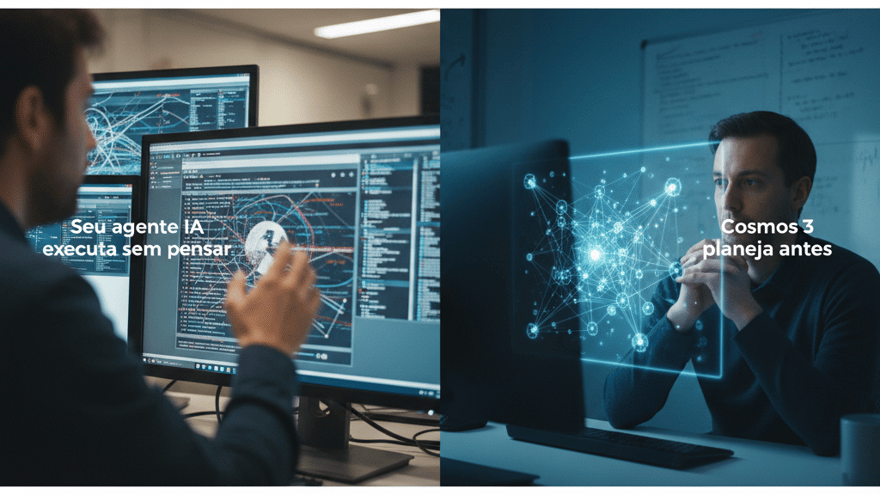
Seu agente IA digital é obsoleto (OpenAI robots são future)
Agente IA é digital (WhatsApp, automação). OpenAI: robots físicos. Digital agente = obsoleto em 3-5 anos.

Equipe OpenClaw · Time de Engenharia & Produto
A Equipe OpenClaw é formada por engenheiros, designers e especialistas em IA dedicados a construir a melhor plataforma de agentes conversacionais para negócios brasileiros. Combinamos expertise…
Seu agente IA digital é obsoleto (OpenAI robots são future)
Você tem SaaS.
Seu SaaS: agente IA (digital, automação via WhatsApp/Slack/API).
Sua estratégia:
"Agente IA é automation digital:
- Customer: 'Preciso automata atendimento'
- You: 'Coloca agente IA em WhatsApp'
- Agente: Responde customer, automata workflow, integra com CRM
- Result: Digital automation (WhatsApp, texto, dados)
Benefit:
- Agente é barato (software, não hardware)
- Agente é rápido (deploy em dias, não meses)
- Agente é scalable (1000 customers, 1 agente cada)
- Agente é global (internet, qualquer lugar)
Business model:
- Customer pays: R$ 500 - R$ 5K/mês por agente
- You profit: R$ 400 - R$ 4K/mês (after costs)
- Scalable: 100 customers = R$ 40K - R$ 400K/mês revenue
Vida é boa (digital automation é future, você ganha dinheiro, customers são happy)."
Then:
You read:
"OpenAI is building robotics team again.
"Goal: Personal robot for everyone ("everyone having a personal robot doing anything they need").
"Timeline: Infrastructure robots in near term (1-2 years), consumer robots later (3-5 years).
"Implication: Physical robots will do what digital agentes do (but physically).
"Example:
- Before: Agente IA responde email no WhatsApp
- After: Robot physically picks up package, delivers to customer
- Before: Agente IA automata warehouse order
- After: Robot physically picks items from shelf, packs box
- Before: Agente IA schedules meeting
- After: Robot physically goes to meeting location, participates
"Result: Physical robots can do 10x more than digital agentes.
"Question: If robots can do it physically, why would customer use digital agente?"
You think:
"Wait.
OpenAI is building personal robots.
Sam Altman's goal is 'everyone having personal robot'.
My agente IA is digital (WhatsApp, automação).
If robots exist: Digital agente becomes less valuable (why use digital if robot can do it physically?).
If robots become cheap (affordable for small biz): My customers will switch to robots (physical > digital).
My product becomes obsolete.
I'm exposed (digital agente = sunset product).
WHAT IS OPENAI DOING?
OpenAI is restarting robotics division (shut down 5 years ago).
Goal: Personal robot for everyone.
Timeline:
- Near term (1-2 years): Infrastructure robots (building, construction, manufacturing)
- Medium term (2-4 years): Commercial robots (warehouse, logistics, delivery)
- Long term (4-10 years): Consumer robots (homes, personal tasks)
Capability:
- Robot can see (vision)
- Robot can reason (planning, decision-making)
- Robot can act (physical manipulation, movement)
Example: Amazon Alexa today vs personal robot tomorrow
- Alexa today: Can answer questions, control smart home, play music
- Robot tomorrow: Can do all Alexa does, PLUS physically get things, clean, organize, help elderly
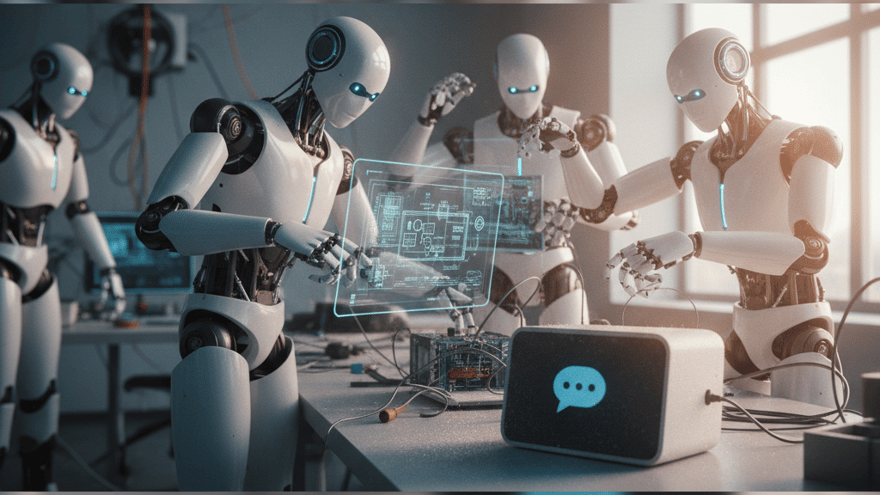
Result: Robot is digital agente + physical body (agente on steroids).
WHY PHYSICAL ROBOTS BEAT DIGITAL AGENTES
Comparison:
Digital agente (yours):
- Can: Process data, respond to messages, automate workflows
- Can't: Physically manipulate world, move things, execute physical tasks
- Limitation: Limited to digital/information tasks
Physical robot (OpenAI future):
- Can: Do everything digital agente does (+ more)
- Can: Physically manipulate world (pick, move, build, deliver)
- Can: Execute physical + digital tasks
- Advantage: 10x more capable
Example 1: Warehouse Automation
Your agente (digital):
- Agente receives order (via API)
- Agente looks up inventory (database query)
- Agente notifies human worker (email/Slack): "Pick item X, pack box Y"
- Human does physical work (pick, pack, label, ship)
- Result: Agente handles info, human handles physical
OpenAI robot (physical):
- Robot receives order (via API, same as agente)
- Robot looks up inventory (database query, same as agente)
- Robot physically goes to shelf, picks item X
- Robot physically moves to packing station, packs box Y
- Robot physically labels and places in shipping bin
- Result: Robot handles info + physical (no human needed)
Winner: Robot (eliminates human, does everything)
Example 2: Customer Service
Your agente (digital):
- Customer calls WhatsApp (agente answers)
- Agente asks questions (in text)
- Agente resolves 70% (common issues)
- Agente escalates 30% to human (complex issues)
- Human talks to customer (phone, video, in-person)
- Result: Agente + human still needed
OpenAI robot (physical):
- Customer asks for help (voice or text)
- Robot understands question (NLP, same as agente)
- Robot either: Solves digitally (fast) OR goes to customer location (in-person help)
- Robot can physically help (if needed): Show product, adjust settings, fix issue
- Robot can escalate to human (if needed): "Let me get my manager"
- Result: Robot handles 90%+ (in-person > digital)
Winner: Robot (in-person help > digital agente, customer happier)
Example 3: Sales/Demo
Your agente (digital):
- Sales agente reaches out (email, WhatsApp, LinkedIn)
- Agente qualifies lead (asks questions via text)
- Agente books demo (calendar integration)
- Human does demo (screen share, video call)
- Result: Agente helps, but human still does heavy lifting
OpenAI robot (physical):
- Robot reaches out (email, chat, voice)
- Robot qualifies lead (via conversation)
- Robot books demo (calendar integration, same as agente)
- Robot shows product: Physically demonstrates (shows device, interaction)
- Robot answers in-person questions (standing next to customer)
- Robot books follow-up meeting (physical or virtual)
- Result: Robot handles entire sales cycle (no human needed)
Winner: Robot (human-like presence > text chat)
O problema (seu agente digital fica obsoleto quando robots existem)
Timeline: When Digital Agente Becomes Obsolete
Year 1-2 (2026-2027):
- OpenAI releases infrastructure robots (industrial use)
- Large enterprises test robots (manufacturing, logistics)
- Robots are expensive (R$ 5M - R$ 50M per robot)
- Your agente still dominates (small/medium biz use cases)
Year 2-4 (2027-2029):
- Robot costs drop (mass production, competition)
- Commercial robots available (R$ 500K - R$ 5M)
- Medium enterprises switch to robots (ROI is positive)
- Your agente customers start asking: "Should we switch to robots?"
Year 4-7 (2029-2032):
- Consumer robots available (R$ 50K - R$ 500K)
- Small businesses can afford robots (R$ 100K, 1 robot per office)
- Your agente customers start switching (robot > digital)
- Market shifts away from digital agente
- Your revenue starts declining
Year 7+ (2032+):
- Personal robots ubiquitous (every home, every office)
- Digital agente is like fax machines (obsolete, irrelevant)
- Your business model is dead (customers use robots, not digital agente)
- You either pivoted or failed
Conclusion: Digital agente has 5-7 year runway (before robots make it obsolete).
Customer Defection Path (Why Customers Will Leave You)
Stage 1: Curiosity (Year 2-3)
- Customer hears about robots
- Customer asks: "Should we get a robot instead of agente?"
- You say: "Robots are too expensive, too early, not ready"
- Customer waits and watches
Stage 2: Feasibility (Year 3-4)
- Robot prices drop (R$ 500K → R$ 200K)
- Robot capabilities improve (can do more tasks)
- Customer calculates ROI: "Robot pays for itself in 2 years"
- Customer asks: "Can we try a robot pilot?"
- You say: "Let's wait, not ready yet"
- Customer gets frustrated (you're delaying, robot is better)
Stage 3: Defection (Year 4-5)
- Competitor (robot company) pitches customer
- Customer tries robot on 1 task
- Robot works (does what agente does, better)
- Customer expands robot usage (more tasks, more robots)
- Customer cancels agente subscription ("We don't need digital agente anymore")
Stage 4: Market Shift (Year 5-7)
- Mass customer defection (from digital agente to robots)
- Your revenue declines 50%+ per year
- Your company is forced to pivot (become robot company, or die)
- If you pivot late: You're 5 years behind OpenAI/Tesla/Boston Dynamics
Conclusion: You have 5-7 years to prepare for robot transition.
Your Options
Option 1: DO NOTHING (Pray robots are slower than expected)
Assumption:
- Maybe robots won't happen (too hard, too expensive)
- Maybe digital agente will always be needed (some tasks stay digital)
- Maybe I can sell to customers who don't want robots
Problem:
- OpenAI/Tesla/Boston Dynamics are serious (invested billions, committed to robots)
- Market forces are strong (cheaper automation > expensive humans)
- Your competitors won't wait (they'll pivot to robots early)
- You'll be left behind (sunset product, declining revenue)
Outcome: BANKRUPTCY (5-10 years)
Risk: HIGH (betting that robots won't happen is foolish)
Option 2: PIVOT TO ROBOTS (Build robot company)
Approach:
- Start building robot (or acquire robot startup)
- Transition your customers from digital agente to robots
- Become competitor to OpenAI/Tesla (good luck)
Problem:
- Hardware is hard (way harder than software)
- Requires billions in R&D (robotics, manufacturing, supply chain)
- You're 5 years behind OpenAI (they have world-class team, funding)
- You can't compete (too late, too expensive, too difficult)
Outcome: FAILURE (you'll burn cash, lose to OpenAI, go bankrupt)
Risk: EXTREME (this is a race you can't win)
Option 3: BECOME ROBOT-AGNOSTIC (Support both digital agente + robots)
Approach:
- Keep building digital agente (for customers who want digital)
- Integrate with robot platforms (partner with OpenAI/Tesla/others)
- Position yourself as: "Agente software that works with robots"
Example:
- Customer has robot (from OpenAI)
- Robot needs agente brain (decision-making, planning)
- You provide agente software (runs on robot, controls robot)
- Customer pays you (for software, not hardware)
- You make money (software margin is good, even if agente is less valuable)
Benefit:
- You stay relevant (agente is still needed, even with robots)
- You don't build hardware (avoid hardware risk)
- You partner with robot companies (leverage their investment)
- You have runway (while robots are being built, you still have digital customers)
Problem:
- Your value decreases (you're just software for robot, not the main product)
- Your margin decreases (you're less essential)
- You need to pivot quick (start now, before customers leave)
- You need partnerships (can't do this alone)
Outcome: SURVIVAL (you'll have smaller business, but it survives)
Risk: MEDIUM (execution risk is high, but better than doing nothing)
Timeline: Start now (2025-2026) to be ready when robots arrive (2027-2029)
Option 4: ACQUIRE/MERGE (Get acquired by robot company or bigger SaaS)
Approach:
- Position yourself as acquisition target
- Get acquired by OpenAI, Tesla, Hugging Face, or enterprise SaaS (Salesforce, HubSpot, etc.)
- Let acquirer figure out robot strategy
- You stay employed, get paid
Benefit:
- You exit before decline (sell high, before market collapses)
- You get paid (acquisition, some equity upside)
- You avoid hard pivot (acquirer handles robot transition)
- You're part of robot ecosystem (work on robot products)
Problem:
- You need to be attractive (good product, good metrics, good team)
- You need to move fast (before market shifts, before you're worthless)
- Acquirer might shut you down (consolidate, eliminate competition)
- You lose control (you're now part of bigger company)
Outcome: FINANCIAL SUCCESS (if acquisition happens before market shift)
Risk: MEDIUM (acquisition might not happen, timing is uncertain)
Timeline: Need to be attractive NOW (before next 2-3 years, when acquirers get serious about robots)
Conclusão: Seu agente IA digital é obsoleto (OpenAI robots são future)
O que você precisa saber:
-
OpenAI is serious about personal robots (CEO Sam Altman committed, billions invested)
- Before: Robotics was shut down (2020)
- Now: Robotics is restarted (2025)
- Result: Personal robots will exist (3-5 years out)
-
Physical robots will do everything digital agentes do (+ physical tasks)
- Digital agente: Can process data, respond to messages, automate workflows
- Physical robot: Can do all that, PLUS physically manipulate world
- Result: Robot is strictly better (10x more capable)
-
Your digital agente will become less valuable (market will shift to robots)
- Today: Digital agente is best option (cheap, easy, scalable)
- Tomorrow: Robots are better option (more capable, can do physical tasks)
- Result: Customers will switch from digital agente to robots
-
You have 5-7 years before market collapse (runway before obsolescence)
- Year 1-2: Robots expensive, your agente still relevant
- Year 3-5: Robots affordable, customers start switching
- Year 5-7: Robot ubiquitous, digital agente is obsolete
- After year 7: Your business is dead (if you didn't pivot)
-
You must decide now (how to respond to robot threat)
- Option 1: Do nothing (BANKRUPTCY)
- Option 2: Pivot to robots (FAILURE, you can't compete)
- Option 3: Become robot-agnostic (SURVIVAL, smaller business)
- Option 4: Get acquired (FINANCIAL SUCCESS, if timing is right)
- Best option: Option 3 or 4 (start now, pivot or acquire within 2-3 years)
Na OpenClaw, ajudamos SaaS a:
- ASSESS robot threat (how likely are robots? How will they impact your business?)
- PLAN robot transition (how to become robot-agnostic? How to partner with robot companies?)
- EXECUTE robot integration (integrate with OpenAI/Tesla/other robot platforms)
- POSITION for acquisition (make your agente attractive to acquirers)
Resultado: Seu agente IA digital é future-proof (works with robots) + você have runway (while robots are being built) + you're acquisition target (if you want exit).
Seu agente IA é digital-only?
OpenAI está construindo robots pessoais.
Você tem 5-7 anos antes que robots façam seu agente obsoleto.
O que você vai fazer?
Assess robot threat + plan robot transition + execute robot integration →
Publicado em 1 de junho de 2026