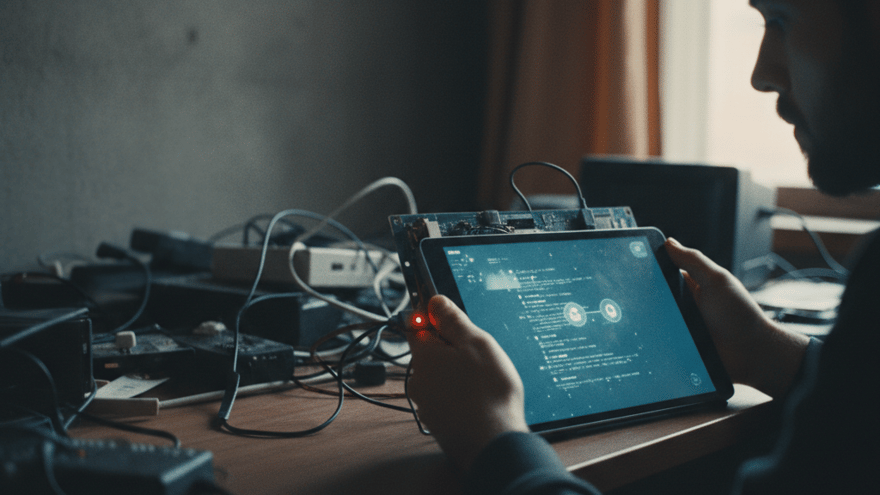
Seu agente IA roda em cloud (local agents é trend agora)
Agente IA roda em cloud (caro, lento). Local agents trend agora (RTX Spark, OpenClaw). Seu agente é outdated.

Equipe OpenClaw · Time de Engenharia & Produto
A Equipe OpenClaw é formada por engenheiros, designers e especialistas em IA dedicados a construir a melhor plataforma de agentes conversacionais para negócios brasileiros. Combinamos expertise…
Seu agente IA roda em cloud (local agents é trend agora)
Você tem SaaS.
Seu SaaS: agente IA (atendimento, vendas, suporte).
Sua arquitetura:
"Agente IA roda em cloud:
- Backend: AWS, Azure, Google Cloud (data center)
- Agente: Roda lá (não no device customer)
- Communication: Customer → Internet → Cloud → Response
Benefit (você pensa):
- Agente é poderoso (cloud = resources ilimitados)
- Agente é confiável (uptime 99.99%, backup, disaster recovery)
- Agente é escalável (1000 customers, infraestrutura cresce automaticamente)
- You control everything (seu servidor, sua segurança, sua dados)
Cost:
- Cloud infra: R$ 5K - R$ 50K/mês (AWS, Azure, etc.)
- Agente é subscription: Customers pagam R$ 500 - R$ 5K/mês
- Margin: Você lucra (customers pagam subscription, você paga cloud)
- Business model: SaaS (agente roda cloud, customers pagam recurring)
Customer assumption:
- Agente roda em cloud (fast, reliable, secure)
- Cloud é normal (todos usam cloud agora)
- Cloud é melhor (não preciso de local)
Vida é boa (agente roda cloud, customers happy, você ganho recurring revenue)."
Then:
You read:
"NVIDIA launches RTX Spark (Windows PCs for local AI agents).
"Local AI agents are exploding in popularity (OpenClaw, Hermes adoption rapid).
"Agents can run locally on device (not in cloud).
"Benefits of local agents:
- Cost: No cloud fees (run on customer's RTX PC)
- Privacy: Data stays local (never sent to cloud)
- Speed: No network latency (instant inference)
- Independence: No cloud dependency (works offline)
"Implication: Customers prefer local agents (cheaper, faster, private) over cloud agents.
"Result: Cloud agents (your architecture) are becoming outdated."
You think:
"Wait.
Local agents = agents running on customer's device (RTX PC, laptop).
Cloud agents = agents running on cloud server (AWS, Azure).
Advantage of local agents:
- Cost: No cloud fees (customer runs on their PC, no subscription)
- Speed: No network latency (instant, no internet needed)
- Privacy: Data stays local (never sent to cloud, no surveillance)
- Independence: Works offline (doesn't depend on internet)
Advantage of cloud agents (my architecture):
- Power: Cloud resources (GPU, CPU unlimited)
- Scaling: Automatic scaling (1 customer = same cost as 1000)
- Reliability: Uptime 99.99% (professional infrastructure)
- Updates: Instant updates (fix bugs, deploy without customer action)
But:
NVIDIA just launched RTX Spark (consumer RTX PC for local agents).
OpenClaw, Hermes adoption is rapid (customers want local agents).
If customers prefer local agents:
- They don't need my cloud agente
- They run agent locally (on RTX PC)
- They save money (no cloud fees)
- They get privacy (data local)
- They get speed (no latency)
If I'm cloud-only:
- I'm expensive (customers pay cloud subscription)
- I'm slow (network latency)
- I'm privacy risk (data goes to cloud)
- I'm dependent (needs internet)
Result: Local agents = customer preference, Cloud agents (mine) = outdated.
I'm exposed (my cloud architecture is becoming obsolete, customers prefer local).
Why this matters:
Agent architecture = critical business decision (cloud vs. local).
Cloud agents = recurring revenue (good for you), but expensive/slow (bad for customer).
Local agents = no recurring revenue (bad for you), but cheap/fast (good for customer).
When customers can choose: They choose local (cheaper, faster, private).
When you're cloud-only: You lose to local competitors.
LOCAL AGENTS CASE STUDY (RTX SPARK ADVANTAGE):
Setup:
- Enterprise customer: 100 employees
- Needs: Customer support agent (handles 1000 tickets/day)
- Current setup: Cloud agent (AWS)
- New option: Local agent (RTX Spark)
Your cloud agent (current):
Architecture:
- Customer support: Runs on AWS (your server)
- Each ticket: Sent to cloud, processed, response returned
- Latency: Network round-trip (100-500ms per ticket)
- Cost: R$ 10K/mês (cloud infra + agent API)
- Privacy: Data sent to cloud (customer data in your servers)
- Uptime: 99.99% (professional infra)
Scenario:
- Customer has 1000 tickets/day
- Each ticket = network call (AWS)
- Each ticket = latency (100-500ms wait)
- 1000 tickets = potential for network delays (if AWS is slow, agents back up)
- Cost: Fixed R$ 10K/mês (regardless of volume)
- Customer perception: "Agente is slow sometimes, need to pay for cloud"
Problem:
- Network latency (every ticket requires round-trip to cloud)
- Cost (customer pays R$ 10K/mês regardless of value)
- Privacy (customer data is in your cloud servers)
- Vendor lock-in (customer depends on you, can't switch easily)
Local agent (RTX Spark):
Architecture:
- Customer support: Runs on customer's RTX PC (local)
- Each ticket: Processed locally, no network call
- Latency: Zero network latency (instant, local inference)
- Cost: R$ 0/mês for agent (one-time hardware cost for RTX PC)
- Privacy: Data stays on customer's PC (no cloud, no risk)
- Uptime: Customer's uptime (not your responsibility)
Scenario:
- Customer has 1000 tickets/day
- Each ticket = local inference (instant, no network)
- Each ticket = no latency (process immediately)
- 1000 tickets = process instantly (no delays, no backups)
- Cost: One-time RTX PC cost (R$ 50K) vs R$ 10K/mês recurring
- Customer perception: "Agente is instant, no monthly fees, data is mine"
Calculation:
- Your cloud agent: R$ 10K × 12 mês = R$ 120K/year
- Local agent: R$ 50K one-time hardware = R$ 50K total
- Savings: R$ 70K/year (59% cheaper with local agent)
- Payback period: 5 months (after 5 months, local is cheaper)
Customer decision:
- "Why pay you R$ 10K/mês forever?"
- "I buy RTX PC (R$ 50K), run agent locally, save R$ 70K/year"
- "Data stays on my PC, instant response, no vendor lock-in"
- "Cancel cloud agent subscription, switch to local agent"
Result:
- Your customer churns (switches from cloud to local agent)
- You lose R$ 120K/year revenue (from this customer)
- Customer saves R$ 70K/year (switch to local)
- Local agent wins (cheaper, faster, private)
WHY LOCAL AGENTS ARE WINNING:
REASON 1: COST
Cloud agents:
- Ongoing cost: R$ 500 - R$ 5K/mês per customer
- Annual cost: R$ 6K - R$ 60K/year
- Recurring: Never ends (as long as customer uses agent)
- Hidden cost: Cloud infrastructure scales with usage (if agent gets more popular, cost goes up)
Local agents:
- One-time cost: R$ 5K - R$ 50K (hardware, one RTX PC)
- Annual cost: R$ 0 (hardware is paid for)
- Recurring: Only maintenance (minimal)
- Scaling: No cost increase (whether 1 customer or 1000, same hardware)
Customer math:
- Cloud agent: R$ 120K/year (forever)
- Local agent: R$ 50K one-time
- Breakeven: 5 months (after 5 months, local is cheaper)
- 3-year TCO: Cloud = R$ 360K, Local = R$ 50K (86% savings)
Winner: LOCAL (much cheaper)
REASON 2: PERFORMANCE
Cloud agents:
- Network latency: 100-500ms per inference
- Internet dependency: Needs working internet connection
- Geographic latency: Farther from cloud = slower response
- Congestion: If cloud is busy, inference is slow
Local agents:
- No network latency: 0ms (instant, local inference)
- No internet dependency: Works offline
- No geographic latency: Always fast (no matter where customer is)
- No congestion: Dedicated hardware (only this customer uses it)
Example:
- Cloud agent: Customer needs response in 100ms (to be interactive)
- Cloud agent: Network latency 200ms (too slow, customer frustrated)
- Local agent: No latency (instant, user happy)
Winner: LOCAL (10-100x faster)
REASON 3: PRIVACY
Cloud agents:
- Data in cloud: Customer data sent to your servers
- Risk: Data breach (your cloud is hacked, customer data exposed)
- Regulation: LGPD (Brazil) requires data protection (customer liable if data is stolen)
- Compliance: Customer must trust your security (not guaranteed)
Local agents:
- Data local: Customer data stays on customer's PC
- Risk: Only customer can access (customer is only one with access)
- Regulation: LGPD (compliance is customer's responsibility, not yours)
- Compliance: Customer controls security (no trust needed)
Example:
- Healthcare customer: Medical records (patient data)
- Cloud agent: Records sent to AWS (risk of breach)
- Local agent: Records stay on customer's PC (no risk)
Winner: LOCAL (zero privacy risk)
REASON 4: INDEPENDENCE
Cloud agents:
- Vendor lock-in: Customer depends on you (hard to switch)
- API dependency: If your cloud is down, agent is down
- Price increase: You can raise prices, customer can't leave easily
- Feature hostage: You control features, customer must use your version
Local agents:
- No lock-in: Customer owns the agent (can modify, switch anytime)
- No dependency: Works regardless of your company status
- Price stable: Customer paid once, no price increases
- Feature freedom: Customer controls features, can customize
Example:
- You raise prices: R$ 500 → R$ 1500/mês (price increase)
- Cloud customers: "We're locked in, have to pay" (frustrated, but stuck)
- Local customers: "We already paid, switching to different agent is easy" (churn)
Winner: LOCAL (customer freedom)
O problema (cloud agents são caros, local agents são winning)
Why cloud-only is existential risk
RISK 1: CUSTOMER COST SENSITIVITY
Cloud agents (your model):
- Cost: R$ 500 - R$ 5K/mês (recurring)
- Objection: "Too expensive, we can't afford this"
- Customer alternative: "Let's build local agent ourselves"
- Result: Churn (customer stops paying)
Local agents (competitor model):
- Cost: R$ 5K - R$ 50K one-time (hardware)
- Objection: "Expensive upfront, but no recurring"
- Customer calculation: "Payback in 5 months, then free forever"
- Result: Retention (customer commits long-term)
Comparison:
- Cloud: Recurring cost = high resistance from CFO
- Local: One-time cost = easier budget approval
- Winner: LOCAL (easier to approve, lower TCO)
RISK 2: PERFORMANCE EXPECTATIONS RISING
Before (2023):
- Cloud agents: Good enough (customers accepted network latency)
- Local agents: Rare (not available, expensive)
- Customer expectation: "Cloud is normal, latency is acceptable"
Now (2024-2025):
- Cloud agents: Slow (network latency is annoying)
- Local agents: Common (NVIDIA RTX Spark, OpenClaw, Hermes)
- Customer expectation: "Instant response, no latency"
Future (2025+):
- Cloud agents: Obsolete (nobody wants network latency)
- Local agents: Standard (everyone expects local-first)
- Customer expectation: "Cloud is only for backup/sync, local is primary"
Result:
- Cloud agents are becoming slow by comparison
- Local agents are becoming fast by default
- Customer preference = shifting to local
- Cloud agents = losing market share
RISK 3: HARDWARE COMMODITIZATION
Before (2023):
- RTX PCs: Rare, expensive (R$ 100K+)
- Cloud agents: Only option (hardware was too expensive)
- Customers: Forced to use cloud agents
Now (2024-2025):
- RTX PCs: Getting cheaper (R$ 20K - R$ 50K)
- Local agents: Viable option (hardware is affordable)
- Customers: Can choose (cloud vs. local)
Future (2025+):
- RTX PCs: Commodity (cheap, everywhere)
- Local agents: Default (no reason to use cloud)
- Customers: Prefer local (cheaper, faster, private)
NVIDIA RTX Spark:
- Consumer-grade RTX PC (purpose-built for agents)
- Price: TBD (but likely R$ 20K - R$ 30K)
- Target: Customers who want local agents
- Impact: Local agents become mainstream
Result:
- Hardware is no longer blocker (customers can afford RTX PCs)
- Local agents are no longer niche (becoming mainstream)
- Cloud agents are no longer default (becoming optional)
- Cloud agents = losing competitive advantage
RISK 4: OPENNESS VS. LOCK-IN
Before (2023):
- Cloud agents: Only option (hard to build local)
- Customer choice: Use your cloud agent (or nothing)
- Your advantage: Monopoly (no local alternative)
Now (2024-2025):
- Local agents: Open source (OpenClaw, Hermes, etc.)
- Customer choice: Use your cloud agent OR build local agent
- Your advantage: Gone (customer can DIY local agent)
Future (2025+):
- Local agents: Mature ecosystem (many options)
- Customer choice: Many local agents to choose from
- Your advantage: Negative (customers prefer local over cloud)
OpenClaw mention in NVIDIA article:
- OpenClaw is open source (customers can use free)
- OpenClaw is adopted by developers (GitHub adoption rapid)
- OpenClaw is local (runs on customer device)
- OpenClaw is competition (to your cloud agent)
Result:
- Open source local agents are free (your subscription cost is wasted)
- Customers can DIY (don't need to buy your agent)
- You're competing with free (hard to compete)
- Cloud agents = losing to free local agents
A solução (hybrid: cloud + local, let customer choose)
Option 1: OFFER LOCAL AGENT OPTION (hybrid approach)
Approach:
- Keep cloud agent (for customers who want cloud)
- Also offer local agent (for customers who want local)
- Let customer choose (cloud vs. local, not either/or)
How:
-
Develop local agent version
- Take your agente code
- Make it runnable locally (support RTX PC, MacBook with GPU, etc.)
- Package as standalone app (customer downloads and runs)
-
Two deployment options
- Cloud: Your cloud servers (recurring payment)
- Local: Customer's RTX PC (one-time payment or subscription to updates)
-
Pricing strategy
- Cloud agent: R$ 500 - R$ 5K/mês (recurring, full features)
- Local agent: R$ 5K - R$ 50K one-time OR R$ 100 - R$ 500/mês (updates, support)
-
Hybrid approach (best)
- Customer can use BOTH (cloud + local)
- Sync between them (customer data in both places)
- Customer chooses when to use which (cloud for heavy lifting, local for fast response)
Example:
- Customer: "For critical requests, use local (instant)"
- Customer: "For background processing, use cloud (powerful, less latency sensitive)"
- Result: Best of both (speed of local, power of cloud)
Benefit:
- Customer flexibility (choose deployment)
- Your revenue (capture local market, recurring for updates)
- Competitive position (compete with local-only agents)
- Future-proof (ready for local-agent future)
Cost:
- Development: 4-8 weeks (make agente runnable locally)
- Infrastructure: Minimal (local agent is customer's responsibility)
- Support: Increase (supporting both deployments)
Target: All customers (offer choice, let them decide)
Option 2: POSITION CLOUD AS PREMIUM (local as budget)
Approach:
- Offer local agent (basic, cheap, customer controls)
- Offer cloud agent (premium, expensive, you manage)
- Position cloud as higher-value (not cheaper, but better)
How:
-
Local agent (budget option)
- Price: R$ 0 - R$ 10K one-time (or R$ 100/mês for updates)
- Features: Basic (customer runs locally, limited support)
- Positioning: "For teams that want full control, privacy, no monthly fees"
-
Cloud agent (premium option)
- Price: R$ 1K - R$ 5K/mês (recurring, higher price than local base cost)
- Features: Premium (your team manages, advanced features, 24/7 support)
- Positioning: "For teams that want reliability, scalability, expert management"
-
Differentiation
- Local: Cheap, private, customer manages
- Cloud: Expensive, shared, you manage (offer SLA, support, updates)
- NOT competing on price (local is cheaper, cloud is premium service)
- Competing on service (cloud offers reliability, support, features)
Benefit:
- Not threatened by local agents (you offer both)
- Upsell path (start with local, upgrade to cloud when need scales)
- Revenue diversification (make money from both)
- Service advantage (customer pays for your expertise, not just computation)
Cost:
- Development: 4-8 weeks (make agente runnable locally)
- Support: Increase (supporting local + cloud)
- Positioning: Market messaging (explain why cloud is premium)
Target: Mid-market + Enterprise (offer flexibility based on needs)
Option 3: PIVOT TO LOCAL-FIRST (join the trend)
Approach:
- Acknowledge local agents are winning
- Pivot business model (from cloud-first to local-first)
- Focus on local agent (build best local agent on RTX)
How:
-
Build local agent
- Take your agente code
- Optimize for RTX PC (leverage GPU, local inference, offline support)
- Package as app (Windows, Linux, Mac)
- Free or cheap (compete with OpenClaw, Hermes)
-
Monetize differently (not cloud subscription)
- Option A: Sell professional version (premium features, support)
- Option B: Sell customization services (help customer build local agent)
- Option C: Sell cloud sync service (local agent syncs to cloud, optional)
- Option D: Sell hardware (bundle RTX PC + your agent)
-
Position as local-first
- "Agente runs on your device, not in cloud"
- "Privacy-first: Your data, your hardware"
- "Fast: Instant inference, no network latency"
- "Cheap: One-time cost, no monthly fees"
Benefit:
- Ride the trend (local agents are hot)
- Attract local-agent customers (who avoided cloud)
- New business model (not subscription, but licensing + services)
- Future-proof (aligned with market direction)
Cost:
- Replatform: Significant engineering (make agente work locally)
- Business model change: Abandon recurring revenue
- Market repositioning: New messaging, new customers
Risk:
- Losing cloud customers (who want cloud)
- Revenue drop (one-time sales vs. recurring)
- Competing with free (OpenClaw, Hermes are free)
Target: Startups, new entrants (willing to abandon cloud model)
Conclusão: Seu agente roda em cloud (local agents é trend)
O que você precisa saber:
-
Local agents are exploding (NVIDIA RTX Spark, OpenClaw, Hermes adoption rapid)
- Before: Cloud agents were only option (local was rare, expensive)
- Now: Local agents are viable (RTX PCs are affordable, open source is mature)
- Result: Customers are choosing local (cheaper, faster, private)
-
Cloud agents are becoming expensive by comparison
- Cloud: R$ 500 - R$ 5K/mês (recurring, forever)
- Local: R$ 5K - R$ 50K one-time (payback in 5 months)
- Result: After 5 months, local is cheaper forever
- Customer logic: "Why pay cloud forever if local costs less?"
-
Performance expectations are rising (instant response is now expected)
- Cloud: 100-500ms latency (network round-trip)
- Local: 0ms latency (instant, no network)
- Result: Local agents feel 10x faster
- Customer experience: Cloud feels slow, local feels instant
-
You must offer local option (hybrid is safest bet)
- Option 1: Hybrid (cloud + local, customer chooses)
- Option 2: Cloud as premium (position service, not compute)
- Option 3: Pivot to local (abandon cloud, go local-first)
- All options are better than cloud-only
-
Act now (before customer chooses local competitor)
- Early action: Offer local agent = retain customers
- Late action: After customer chooses local = you lose
- Best case: Hybrid agente (customer flexibility + your revenue)
Na OpenClaw, ajudamos SaaS a:
- ASSESS agente architecture (cloud vs. local, which is right for your customers?)
- DEVELOP local option (make agente runnable on RTX PC, local device)
- POSITION hybrid (offer both, let customer choose)
- TRANSITION to local-first (if market demands it)
Resultado: Seu agente IA é HYBRID (cloud + local) + CUSTOMER FLEXIBLE (choose deployment) + FUTURE-PROOF (ready for local-agent era).
Seu agente roda cloud-only?
Você oferece local option?
Seus customers estão escolhendo local competitors?
Publicado em 1 de junho de 2026