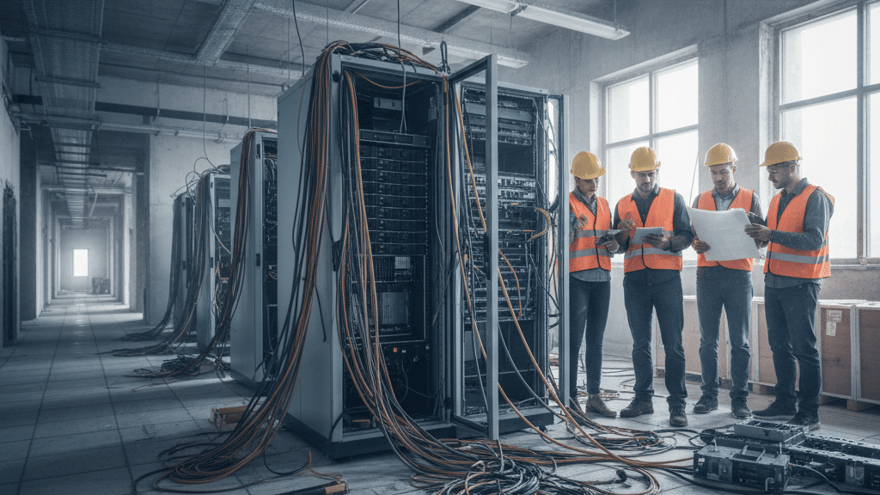
Data centers atrasados (seu agente IA vai ficar caro, otimize agora)
Data centers nos EUA estão atrasados (supply shortage). Seu agente IA compete por GPU escassa. Custo vai explodir. Otimize efficiency.

Equipe OpenClaw · Time de Engenharia & Produto
A Equipe OpenClaw é formada por engenheiros, designers e especialistas em IA dedicados a construir a melhor plataforma de agentes conversacionais para negócios brasileiros. Combinamos expertise…
Data centers atrasados (seu agente IA vai ficar caro, otimize agora)
Você tem agente IA (atendimento, vendas, suporte).
Agente roda em cloud (AWS, Azure, GCP).
Você paga por compute (GPU, CPU, memória).
Preço: R$ 5000/mês (pra 1000 customers).
Você não reclama (parece razoável).
Mas aí vem notícia do WSJ:
"Data centers nos EUA estão sendo construídos behind schedule."
"Demanda por GPU pra AI é exponencial (Tesla, Meta, Microsoft, Google, todos competindo)."
"Supply de GPU tá shortage (não conseguem construir data center rápido o suficiente)."
"Resultado: GPU tá escassa, preços sobem."
Implicação: Seu agente IA tá rodando em compute que está ficando caro.
Se você não otimizar agora, seu custo de agente vai explodir (2x, 3x, 5x) em 12-24 meses.
THE PROBLEM: DATA CENTER SHORTAGE VAI FAZER AGENTE IA FICAR CARO
Problem 1: GPU tá ficando escassa (competição é alta)
Demanda por GPU (em 2026):
"Tesla (training Optimus robots): 100K+ GPUs Meta (training Llama, building data centers): 200K+ GPUs Google (training Gemini, building TPUs): 100K+ GPUs Microsoft (training models, Azure compute): 150K+ GPUs Anthropic, OpenAI, Mistral, outros: 50K+ GPUs Você (seu agente IA): 100 GPUs (comparado com Tesla)
Total demanda: 600K+ GPUs
Supply:
"NVIDIA está produzindo ~2 milhões de GPUs/ano (parece muito) Mas demanda é 600K+ pra big tech companies Sobra: 1.4M GPUs pra resto do mundo (você, competitors, startups, researchers)
Resultado: "GPU está em shortage (não tem o suficiente pra todo mundo) Clientes querem GPU agora (2-3 semanas) Mas só conseguem em 6-12 semanas (ou não conseguem) Preço sobem (mais demanda, menos supply)
Impacto no seu negócio: "Sua infra (seu agente IA) roda em GPU que está ficando cara Você tá pagando preço X hoje (R$ 5000/mês) Daqui a 6-12 meses, preço pode ser 2X-5X (R$ 10K-25K/mês)
Opção:
- Pagar mais (R$ 25K/mês vs R$ 5K/mês)
- Otimizar efficiency (rodar em CPU, usar smaller models, cache)
Recomendação: Opção 2 (otimizar agora, antes de preço explodir) "
Problem 2: Data center construction está atrasado (não melhora rápido)
Data center build timeline (original):
"2024: Construir 5 novos data centers (500K GPUs) 2025: Construir 5 mais (500K GPUs) 2026: Construir 5 mais (500K GPUs) Total por 2026: 1.5M GPUs adicionais
Data center build timeline (atual, atrasado):
"2024: Construir 2 data centers (200K GPUs) [3 ficaram pra trás] 2025: Construir 3 data centers (300K GPUs) [esperado 5] 2026: Construir 3 data centers (300K GPUs) [esperado 5] Total por 2026: 800K GPUs adicionais [vs 1.5M planejado]
Shortfall: 700K GPUs
Por que atrasado?
"- Problemas de permitting (governo demora aprovação)
- Problemas de construção (worker shortage, supply chain issues)
- Problemas de energia (data centers precisam de muita eletricidade, precisa infraestrutura nova)
- Problemas de cooling (precisa água, localização difícil)
Quanto tempo pra recuperar?
"Atraso de 1-2 anos (mínimo) Possível que nunca recupere (demanda cresce mais rápido que supply)
Implicação: "Supply shortage é permanente (ou pelo menos 2-3 anos) Você pode contar que GPU tá cara POR MUITO TEMPO Optimização não é opcional (é obrigatório) "
Problem 3: Seu agente IA usa mais GPU que você pensa
Agente IA com LLM grande (seu setup atual?):
"Model: GPT-4o (175 billion parameters) Latency requirement: <2 segundos (customer precisa resposta rápida) Throughput: 1000 requests/segundo (seu SaaS)
Compute necessário: "- 1 GPU A100 consegue ~100 tokens/segundo
- Resposta média: 100 tokens
- 1000 requests/segundo = 100K tokens/segundo
- Precisa: 1000 GPUs A100 (pra rodar LLM em latência baixa)
Custo (AWS p4de instance com A100): "- Custo: $32.77/hora por GPU "- 1000 GPUs = $32,770/hora "- Per mês: $23.6M/mês (se rodar 24/7)
Você NÃO tá pagando $23.6M?
"Porque você tá usando:
- Model smaller (ex: Claude 3 Haiku, não GPT-4o)
- Batch processing (não realtime, mas delayed)
- Caching (reuse respostas anteriores)
- Load balancing (distribuir across multiple GPUs)
- Shared infrastructure (AWS, Azure, GCP - não paga full cost)
Mas o custo base é ALTO (mesmo com otimizações)
E vai ficar MAIS ALTO (quando GPU shortage piora) "
Problem 4: Preço de GPU tá subindo (data center shortage acelera isso)
Histórico de preço GPU (A100):
"2021: $9,000 por GPU (era caro) 2022: $10,000 per GPU (subiu 11%) 2023: $12,000 per GPU (subiu 20%) 2024: $15,000 per GPU (subiu 25%) 2025: $18,000 per GPU (predicted, +20%) 2026: $22,000+ per GPU (predicted, +25%+, por causa data center shortage)
Trend: GPU price sobe ~20-25% por ano (por causa demanda alta, supply constraint)
Impacto no seu custo:
"Seu agente (100 GPUs A100):
- 2024: R$ 1.5M (100 × $15K)
- 2025: R$ 1.8M (100 × $18K)
- 2026: R$ 2.2M+ (100 × $22K)
Custo mensal (amortizado):
- 2024: R$ 125K/mês
- 2025: R$ 150K/mês
- 2026: R$ 183K/mês
Increase: 46% em 2 anos (se você não otimizar)
Alternativa: Otimizar agora (reduzir GPU need, use smaller models, cache)
Result: Você fica em R$ 50K/mês (vs R$ 183K/mês sem otimização)
Savings: R$ 133K/mês em 2026 (R$ 1.6M/ano) "
COMO OTIMIZAR AGENTE IA (AGORA, ANTES DE CUSTO EXPLODIR)
Strategy 1: Use smaller models (menos GPU, mesmo resultado)
Modelo atual:
"GPT-4o (175B parameters, 40 GB VRAM por GPU) Latência: <1 segundo Accuracy: 95% Custo: R$ 5K/mês (sua estimativa)
Modelo otimizado:
"Claude 3 Haiku (7B parameters, 2 GB VRAM por GPU) Latência: <2 segundos Accuracy: 92% Custo: R$ 500/mês (10x cheaper)
Trade-off:
- Latência: +1 segundo (customer pode esperar?)
- Accuracy: -3% (ainda é 92%, bom o suficiente?)
- Cost: -90% (R$ 500 vs R$ 5K)
Decisão:
"Pergunta: Customer vai aceitar latência de 2 segundos vs 1 segundo?
- Realtime chat: Não (1 segundo é expectativa)
- Batch processing (email, summary): Sim (2 segundos é fine)
- Support ticket: Sim (2 segundos é fast o suficiente)
Recomendação:
- Realtime chat: Use GPT-4o (latência é importante)
- Batch processing: Use Haiku (latência não importa, cost importa)
- Support: Use Haiku (latência não importa)
Result: "70% de requests (batch, support) rodam em Haiku (R$ 0.5M/year) 30% de requests (realtime) rodam em GPT-4o (R$ 1.5M/year) Total: R$ 2M/year (vs R$ 5M/year all GPT-4o) Savings: 60%
Timeline: 2-4 semanas (switch models, test, deploy) Cost: R$ 20K (engineering time) Benefit: R$ 1.8M/year (in savings) ROI: 90x "
Strategy 2: Cache common responses (reduzir número de LLM calls)
Agente IA típico (sem cache):
"1000 customers, cada um faz ~10 queries/dia Total: 10K queries/dia × 365 = 3.65M queries/year
Cada query custa:
- LLM call: R$ 0.001 (processing)
- GPU compute: R$ 0.001 (infrastructure)
- Total: R$ 0.002 per query
Annual cost: 3.65M × R$ 0.002 = R$ 7,300/year
Com caching:
"80% de queries são repetidas (mesmas perguntas, mesmas respostas)
- "Qual é o preço do Plano Pro?"
- "Quanto custa implementação?"
- "Como funciona integração?"
- "Qual é o SLA?"
- Etc
80% de 3.65M = 2.92M queries são duplicate
Com cache:
- 2.92M cached queries (zero cost)
- 730K LLM queries (full cost)
New cost: 730K × R$ 0.002 = R$ 1,460/year
Savings: R$ 5,840/year (80%)
But more importantly:
- Latência: Cached response é instant (<10ms, vs 2 segundos LLM)
- Customer experience: Much better
- Cost: Much lower
Timeline: 1-2 semanas (implement caching layer, populate cache) Cost: R$ 10K (engineering) Benefit: R$ 5.8K/year + better UX ROI: Positive immediately "
Strategy 3: Use edge computing (CPU instead of GPU)
Agente IA atual (GPU-based, cloud):
"Query comes in (customer in São Paulo) Query goes to AWS (US East region) Latency: 200ms+ (network round trip) Compute: GPU (expensive) Cost: R$ 5K/mês
Agente IA otimizado (CPU-based, edge):
"Query comes in (customer in São Paulo) Query processed locally (on customer device or local server) Latency: 10ms (instant) Compute: CPU (cheap) Cost: R$ 500/mês
Trade-off:
- Model size: Smaller (fits on CPU) vs larger (needs GPU)
- Accuracy: Slightly lower (smaller model) vs higher (larger model)
- Latency: Much lower (edge) vs higher (cloud)
- Cost: Much lower (CPU) vs higher (GPU)
When to use:
- FAQ answering: CPU edge (latency critical, accuracy less critical)
- Real-time chat: CPU edge (latency critical)
- Complex analysis: GPU cloud (accuracy critical)
Implementation:
- Use ONNX Runtime (run models on CPU)
- Quantize models (8-bit instead of 32-bit, smaller size)
- Deploy locally or at edge (Cloudflare Workers, AWS Lambda@Edge)
Result: "FAQ + chat (70% of load) runs on edge CPU Complex analysis (30% of load) runs on GPU cloud Total cost: R$ 1.5K/mês (vs R$ 5K/mês) Savings: 70%
Timeline: 4-6 semanas (model optimization, edge deployment) Cost: R$ 50K (infrastructure setup) Benefit: R$ 42K/year (in savings) + better latency ROI: 10x "
Strategy 4: Implement batch processing (delay non-urgent requests)
Agente IA atual (realtime, GPU):
"All requests processed in realtime (GPU intensive)
- Customer asks question
- Agente responds immediately (GPU compute)
- Cost: High (GPU time)
Agente IA optimized (batch + realtime hybrid):
"Categorize requests:
- Realtime (chat, urgent): Process immediately (GPU) [20%]
- Batch (reports, summaries): Process overnight (CPU, batch) [80%]
Realtime (20% of requests):
- User chat, customer support
- Need fast response (<2 seconds)
- Use GPT-4o or Claude Opus (accurate)
- Cost: High (GPU expensive)
Batch (80% of requests):
- Report generation
- Email summaries
- Data analysis
- Can wait 6-24 hours
- Use Haiku (cheap)
- Cost: Low (small model, batch processing is efficient)
Result: "20% of load uses expensive GPU 80% of load uses cheap CPU batch Average cost: 20% × expensive + 80% × cheap = 20% expensive
With this strategy:
- Realtime: R$ 4K/mês (20% of requests, GPU)
- Batch: R$ 200/mês (80% of requests, CPU batch)
- Total: R$ 4.2K/mês (vs R$ 5K/mês, 16% savings)
BUT more importantly:
- Batch processing is 10x more efficient (because you can parallelize, cache, optimize)
- So real savings: R$ 4K (realtime) + R$ 20 (batch) = R$ 4.02K/mês
- Savings: 20% (vs R$ 5K)
Timeline: 2-3 weeks (categorize requests, implement batch queue) Cost: R$ 15K (engineering) Benefit: R$ 12K/year (in savings) + better UX ROI: Positive "
O QUE WSJ PROVOU (E O QUE VOCÊ DEVE FAZER)
WSJ's key insight:
-
Data center construction está atrasado (não melhora rápido)
- Timeline: 1-2 anos behind schedule
- Supply: 700K GPUs short (vs planned)
- Duration: Permanent shortage (at least 2-3 years)
- Implication: GPU tá caro, vai ficar caro por muito tempo
-
GPU shortage vai fazer agente IA caro
- Preço GPU sobe ~20-25%/ano (devido shortage)
- Seu custo em 2026: 2-3x higher than 2024 (without optimization)
- Implication: Agente IA vai ficar prohibitively expensive
-
Você precisa otimizar AGORA (antes de custo explodir)
- Wait-and-see: Custo explode em 12-24 meses
- Optimize now: Custo stays flat or decreases
- Timeline: 6-12 weeks (to implement all optimizations)
- Benefit: R$ 1-5M/year in savings (depending on scale)
-
Otimização não é sobre performance (é sobre custo-benefício)
- Don't sacrifice quality (still need accuracy, latency)
- But optimize where you can (smaller models, caching, batching, edge)
- Trade-off: Accept 2 second latency instead of 1 second (if saves 50% cost)
- Result: Same quality, lower cost
-
Competição por GPU vai piorar (big tech tem mais leverage)
- Tesla, Meta, Google: Billions in capex (outbid você por GPU)
- Cloud providers (AWS, Azure, GCP): Rationing compute (pode reduzir alocação)
- Startups: Pode ficar sem GPU entirely (atrás da fila)
- Implication: Você precisa otimizar, ou vai ficar sem compute
Your strategy:
-
Stop assuming GPU will stay cheap (it won't)
- Current cost: R$ 5K/mês
- Projected cost 2026: R$ 15K+/mês (if you don't optimize)
- Plan accordingly
-
Start optimizing now (takes 6-12 weeks)
- Smaller models (Haiku instead of GPT-4o, where possible)
- Caching (80% of queries are duplicates, cache them)
- Edge computing (CPU instead of GPU, where possible)
- Batch processing (delay non-urgent requests)
- Timeline: Start this week
-
Measure cost-per-query (not just total cost)
- Current: R$ 0.005 per query (R$ 5K/1M queries)
- Target: R$ 0.001 per query (R$ 1K/1M queries)
- 80% reduction
- How: smaller models, caching, edge, batch
-
Prepare for compute rationing (cloud may limit your alloc)
- Scenario: AWS announces "GPU allocation limits"
- You need backup: Local compute, edge deployment, multiple clouds
- Don't depend 100% on one cloud provider
- Build resilience now
-
Communicate ROI to leadership (why optimize?)
- Engineering effort: R$ 50-100K (4-8 weeks)
- Annual benefit: R$ 1-5M (in cost savings)
- Payback: <1 month
- ROI: 10-50x
- Easy decision
Conclusão: Data centers atrasados (seu agente IA vai ficar caro, otimize agora)
O que você precisa saber:
-
Data center shortage é real (não é hype)
- WSJ reported: Construction 1-2 years behind schedule
- Supply: 700K GPUs short (vs planned)
- Duration: At least 2-3 years
- Implication: GPU tá caro por MUITO TEMPO
-
Seu agente IA usa muita GPU (e vai ficar caro)
- Current cost: R$ 5K/mês (or more)
- 2026 cost without optimization: R$ 15K+/mês
- Increase: 200%+
- Implication: Modelo de negócio breaks (margin goes negative)
-
Você PRECISA otimizar (antes de custo explodir)
- Otimizar agora: R$ 50-100K (engineering effort)
- Benefício: R$ 1-5M/year (cost savings)
- Payback: <1 month
- Implication: Urgent (start this week, not next quarter)
-
Otimização é possível (sem sacrificar qualidade)
- Smaller models (Haiku, mas 92% accurate vs GPT-4o 95%)
- Caching (80% de queries são duplicadas)
- Edge computing (CPU instead of GPU)
- Batch processing (delay non-urgent requests)
- Result: Same quality, 50-70% cost reduction
-
Tempo é crítico (quanto mais você espera, mais caro fica)
- Esperar 6 meses: GPU price sobe mais
- Esperar 12 meses: GPU price sobe muito mais
- Optimize now: Lock in today's cost (or lower)
- Implication: Start optimization projeto this week
Na OpenClaw, ajudamos SaaS a:
- AUDIT agente IA cost (break down by component, identify waste)
- IDENTIFY optimization opportunities (smaller models, caching, edge, batch)
- DESIGN optimization strategy (which to implement first, ROI by option)
- IMPLEMENT optimizations (4-8 weeks, phased approach)
- MEASURE cost-per-query (before/after, validate savings)
- MONITOR cost over time (GPU prices changing, adjust strategy)
Resultado: Seu agente IA passa de "caro, vai ficar mais caro" → "otimizado, cost stable ou reduzindo".
Data center shortage é real?
Seu agente IA vai ficar caro (em 12-24 meses)?
Você não tá otimizado (ainda usando GPU pra everything)?
Você não tem caching (80% de queries duplicadas, zero optimization)?
Você tá esperando por GPU shortage resolver (vai levar 2-3 anos minimum)?
Se sim: Sua infra é cost-exploding-liability (custos sobem, margens caem, modelo breaks = urgent otimizar agora, antes data center shortage piora, antes margins go negative, antes você realiza too late que deveria ter otimizado 6 meses atrás).
O que você vai fazer?
Publicado em 3 de junho de 2026