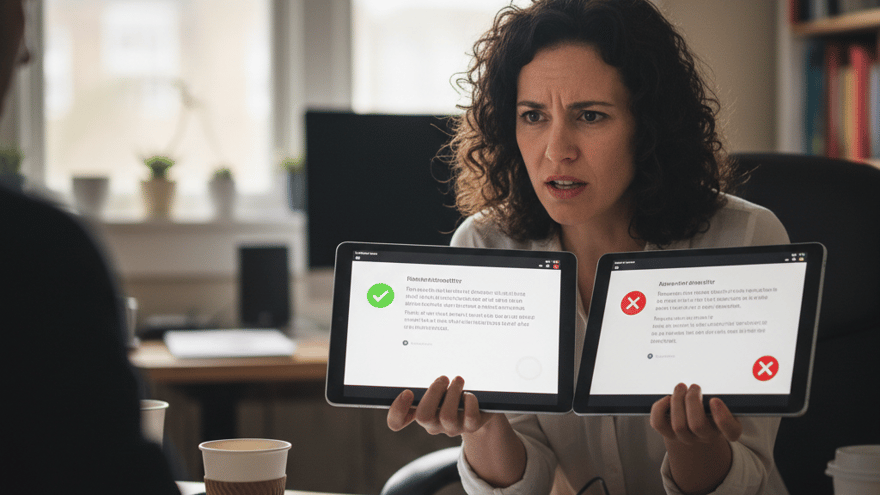
Seu agente IA coleta biometria (legal liability coerciva)
Headway forçou facial scan (coerção). Seu agente coleta biometria também. Quando coleta é coerciva, agente é lawsuit.

Equipe OpenClaw · Time de Engenharia & Produto
A Equipe OpenClaw é formada por engenheiros, designers e especialistas em IA dedicados a construir a melhor plataforma de agentes conversacionais para negócios brasileiros. Combinamos expertise…
Seu agente IA coleta biometria (legal liability coerciva)
Você tem SaaS.
Seu SaaS: agente IA no WhatsApp (atendimento).
Seu agente coleta dados de customer:
- Nome (required)
- Email (required)
- Número de CPF (required, pra identificação)
- Foto de documento (required, pra verificação)
Você think:
"Dados são necessários pra identificar customer.
Sem dados, não consigo verificar se é customer legítimo.
É tudo acima board (KYC compliance)."
MAS:
Recent news (May 2026):
"Headway (therapy app) forçou facial scan pra manter acesso.
Pacientes precisavam fazer facial scan pra continuar therapy.
Se recusava facial scan → therapy era bloqueada.
Isso é coerção (condicional ao serviço).
Resultado: Lawsuits (biometric data privacy violation).
Você pensa:
"WTF? Facial scan é coerção?
Mas meu agente coleta foto de documento (KYC).
É coerção?
Vou ser processado?"
Resposta:
DEPENDE.
Se coleta é NECESSÁRIA + TRANSPARENTE + OPT-IN = OK (compliance).
Se coleta é COERCIVA (condicional, sem alternativa) = NOT OK (lawsuit risk).
Headway: Coleta foi COERCIVA (facial scan obrigatória pra continuar therapy).
Seu agente: Pode estar COERCIVA também (foto CPF obrigatória, sem alternativa).
O problema (coercive biometric collection = lawsuit)
Headway case (real example of coercion)
HEADWAY THERAPY APP:
Setup:
- Headway = therapy app (online mental health)
- Patients = therapy users
What happened:
- Headway added facial recognition requirement
- Reason: "Identity verification (prevent fraud)"
- How: Patients must scan face to access therapy
Coercion:
- Patients want therapy (need mental health support)
- Headway says: "Scan your face OR no therapy"
- Choice: Therapy + face scan, OR no therapy
- Result: Patients FORCED to scan face (no real choice)
Reason it's coercion:
- Essential service (therapy/mental health)
- No alternative (can't refuse facial scan)
- Conditional (face scan = access to therapy)
- Vulnerable population (mental health patients)
Consequence:
- Patients filed lawsuits (biometric privacy violation)
- Regulatory attention (data privacy agencies)
- Reputational damage ("App forces facial scanning")
- Cost (legal fees, settlements, compliance overhaul)
Why coercive collection is illegal (3 laws violated)
LAW 1: LGPD (Lei Geral de Proteção de Dados - Brazil)
Article 7: Personal data processing requires "explicit consent"
Coercive collection = NOT explicit consent:
- Explicit = informed, voluntary, freely given
- Coercive = forced (no real choice)
- Example: "Scan face OR no therapy" = not freely given
Penalty:
- Fine: Up to R$ 50 million (or 2% of revenue)
- Class action lawsuits (customers suing)
- Regulatory agency action (ANPD)
LAW 2: GDPR (EU data protection - if you have EU customers)
Article 4: Consent must be "freely given"
Coercive collection = NOT freely given:
- Freely = no coercion, no consequences for refusal
- Coercive = consequences for refusal (service denial)
- Example: "Facial scan OR no account" = not freely given
Penalty:
- Fine: Up to €20 million (or 4% of global revenue)
- Class action lawsuits (customers suing)
- Service suspension (can't process EU data)
LAW 3: CCPA/CPRA (California data protection - if you have CA customers)
Article 1798.100: Right to know what data is collected Article 1798.105: Right to delete data Article 1798.120: Right to opt-out of sale
Coercive collection = violates rights:
- Right to know = customer must be told what data, why, how long
- Right to delete = customer must be able to delete data
- Right to opt-out = customer must be able to refuse
- Coercive = no real opt-out (deny service if refuse)
Penalty:
- Fine: Up to $7,500 per violation (intentional)
- Class action lawsuits (customers suing)
- Injunctive relief (stop data processing)
3 types of coercive collection (how agente violates)
TYPE 1: CONDITIONAL COLLECTION (deny service if refuse)
Example: WhatsApp agente for customer support
Coercive:
- "To access support, you must provide: name, email, CPF photo"
- Customer: "I don't want to share CPF photo"
- Agente: "You can't access support without CPF photo"
- Customer: FORCED to provide CPF photo (no alternative)
Why it's coercive:
- Service is essential (customer support)
- No alternative (can't get support without photo)
- Conditional (photo = access)
- Result: Implicit coercion (customer has "choice" but only one real option)
TYPE 2: ESCALATING COLLECTION (ask for more data over time)
Example: Sales agente on WhatsApp
Start:
- Conversation 1: "Name, email (basic info)"
- Customer provides
Escalate:
- Conversation 5: "Phone number (contact)"
- Customer provides (habit)
Escalate more:
- Conversation 10: "CPF, date of birth (identity)"
- Customer provides (already invested in relationship)
Facial scan:
- Conversation 20: "Facial scan (biometric)"
- Customer: "Why?"
- Agente: "To verify you're not bot (fraud prevention)"
- Customer: FORCED (already invested, "just one more data point")
Why it's coercive:
- Incremental (customer didn't know final ask)
- Habitual (customer already sharing, hard to say no)
- Justified ("fraud prevention")
- Result: Sunk cost fallacy (customer trapped)
TYPE 3: HIDDEN COLLECTION (collect without asking)
Example: Agente that listens to calls
Coercive:
- Agente policy: "All calls recorded for quality assurance"
- Customer: Not clearly informed (hidden in T&Cs)
- Customer: Thinks call is private, but it's recorded
- Customer: FORCED to accept (no choice, unaware)
Why it's coercive:
- Hidden (not transparent)
- No opt-out (can't refuse recording)
- Biometric (voice is biometric data)
- Result: Violation of consent (customer didn't consent, unaware)
Legal consequence (lawsuit scenario)
SCENARIO: Your agente requires facial scan
Customer journey:
- Customer uses WhatsApp agente (atendimento)
- Agente asks: "Scan your face (verify ID)"
- Customer refuses: "I don't want to share face data"
- Agente blocks: "Can't proceed without facial scan"
- Customer escalates (tweets, posts on internet)
- Media picks up: "SaaS company forces facial scans"
Lawsuit:
- Customer files claim: "Coercive biometric collection"
- Lawyer points to LGPD/GDPR: "Consent wasn't freely given"
- Court agrees: "Facial scan condition = coercion"
- Fine: R$ 50 million (LGPD) or more
- Class action: Other customers join (becomes group lawsuit)
- Damages: Customers owed compensation (privacy violation)
- Injunction: You must delete all facial scans (regulatory order)
Your cost:
- Legal fees: R$ 5-10 million
- Fines: R$ 50 million+
- Settlements: R$ 20-50 million (class action)
- Remediation: R$ 10+ million (delete data, system overhaul)
- Reputational: Massive ("Company forced face scans")
- Business: Destroyed (customers leave, media blacklist)
Total: R$ 135+ million, reputation destroyed, maybe business closed.
And all you needed was: Better consent + opt-in + alternative methods.
Solução (consent > coercion)
Passo 1: AUDIT your current collection (is it coercive?)
QUESTIONS TO ASK:
-
Is collection CONDITIONAL?
- "Facial scan required to access feature" = conditional (coercive)
- "Facial scan optional (but recommended)" = optional (OK)
- Action: Make collection opt-in (not required)
-
Is there ALTERNATIVE?
- "Facial scan OR no support" = no alternative (coercive)
- "Facial scan OR email verification OR ID document" = alternatives (OK)
- Action: Provide alternative methods (don't force facial scan)
-
Is CONSENT EXPLICIT?
- Hidden in T&Cs = not explicit (coercive)
- Clear popup "We want to collect facial data. Do you agree?" = explicit (OK)
- Action: Ask explicit consent (not buried)
-
Can customer REFUSE without PENALTY?
- Refuse facial scan → blocked from service = penalty (coercive)
- Refuse facial scan → can use service anyway (slower?) = OK
- Action: Allow refusal (no service denial)
-
Is collection NECESSARY?
- "Facial scan to prevent fraud" = maybe necessary (context)
- "Facial scan for better UX" = not necessary (not OK)
- Action: Only collect if truly necessary (justify why)
ACTION: Audit your agente
- List all data collected (name, email, phone, CPF, face, voice, etc)
- For each: Is it conditional? Is there alternative? Is consent explicit?
- If conditional + no alternative + not explicit = COERCIVE (fix now)
Passo 2: REDESIGN collection (consent-first, not coercive)
OLD DESIGN (coercive):
Step 1: Customer enters WhatsApp Step 2: Agente: "Provide: name, email, CPF, face photo" Step 3: Customer: "Why do I need to provide all this?" Agente: "Required to proceed" Step 4: Customer: FORCED (no choice)
Result:
- Collection is conditional (photo required)
- No alternative (must provide photo)
- No clear consent (buried in requirements)
- Coercive (customer forced)
- Legal risk: LAWSUIT
NEW DESIGN (consent-first):
Step 1: Customer enters WhatsApp Step 2: Agente: "Hi! I'm here to help. I'll need some info..." Step 3: Agente shows consent flow:
- "Basic info (name, email)" → REQUIRED (for service)
- "Phone number" → OPTIONAL (for follow-up, you can skip)
- "CPF (tax ID)" → OPTIONAL (if you want invoice, you can skip)
- "Facial scan (biometric)" → OPTIONAL (extra security, recommended but not required)
- "Call recording" → OPTIONAL (quality assurance, you can disable)
Step 4: Customer chooses:
- Accept all? YES → proceed with all data
- Accept only required? YES → proceed with basic info only
- Refuse facial scan? YES → proceed without facial (alternative: email verification)
- Refuse call recording? YES → proceed without recording
Step 5: Agente adapts:
- If no facial scan → use email verification (alternative)
- If no call recording → just text transcript (alternative)
- Customer controls data (not forced)
Result:
- Collection is opt-in (not conditional)
- Alternatives provided (customer chooses)
- Explicit consent (clear popup, customer clicks YES)
- Voluntary (customer controls)
- Legal safe: COMPLIANT
Passo 3: IMPLEMENT consent management (prove you have consent)
TECHNICAL IMPLEMENTATION:
-
CONSENT DATABASE
- Log every consent decision (customer ID, what they consented to, when, how)
- Prove: "Customer explicitly consented to facial scan on 2026-05-29"
- Also log: "Customer refused call recording on 2026-05-29"
- Purpose: Legal defense (prove consent was given, prove respect for refusal)
-
CONSENT UI
- Clear checkbox: "I consent to facial scan"
- NOT: Hidden in T&Cs
- NOT: Pre-checked box (customer must click)
- NOT: "Required" label (unless truly required)
- Purpose: Explicit consent (customer actively chooses)
-
CONSENT DURATION
- "Valid until: 2027-05-29" (expires after 1 year)
- Customer can revoke anytime: "Withdraw consent"
- When revoked: "Delete all facial scans (your request)"
- Purpose: Ongoing consent (not permanent, customer controls)
-
CONSENT TRANSPARENCY
- Customer can see: "What data do you have on me?"
- Customer can see: "What consent did I give?"
- Customer can see: "When will you delete it?"
- Purpose: Trust (customer knows, controls)
EXAMPLE CONSENT FLOW:
Customer: Starts WhatsApp chat with agente
Agente: "Hi! I'm here to help you. I'll ask for some info. You control what you share."
[CONSENT POPUP]
┌─────────────────────────────────────────┐ │ WHAT DATA DO WE NEED? │ │ │ │ ☑ Name & Email (REQUIRED) │ │ Why: Identify you, send updates │ │ Duration: 12 months │ │ │ │ ☐ Phone number (OPTIONAL) │ │ Why: Send SMS reminders │ │ Duration: 12 months │ │ You can skip or refuse later │ │ │ │ ☐ Facial scan (OPTIONAL) │ │ Why: Extra security (prevent fraud) │ │ Duration: 12 months │ │ ALTERNATIVE: Email verification OK │ │ You can refuse, we'll use email │ │ │ │ ☐ Call recording (OPTIONAL) │ │ Why: Quality assurance │ │ Duration: 30 days then delete │ │ ALTERNATIVE: No recording OK │ │ You can disable anytime │ │ │ │ [ACCEPT SELECTED] [CUSTOMIZE] │ │ │ │ Questions? [LEARN MORE] │ │ Privacy policy: [LINK] │ └─────────────────────────────────────────┘
Customer clicks "ACCEPT SELECTED":
- Name & Email: ACCEPTED ✓
- Phone: REFUSED ✗
- Facial: REFUSED (email verification instead) ✗
- Call recording: REFUSED ✗
Agente adapts:
- Uses name/email (accepted)
- Skips SMS (refused)
- Uses email verification (alternative to facial)
- No call recording (refused)
Customer controls = No coercion = Legal safe.
Passo 4: HANDLE refusal gracefully (no penalty)
WHEN CUSTOMER REFUSES FACIAL SCAN:
Bad approach (coercive):
- Agente: "Sorry, facial scan is required. Can't proceed."
- Customer: BLOCKED (forced to refuse service)
- Legal risk: Coercive (no real choice)
Good approach (respectful):
- Agente: "Understood. Facial scan is optional."
- Agente: "Here's alternative: Email verification (same security)"
- Agente: "Send verification email to john@example.com?"
- Customer: "Yes"
- Agente: Proceeds (no facial needed)
- Result: Service works, no facial data collected, customer happy
Key: Customer refuses facial → agente uses alternative (not blocking).
WHEN CUSTOMER WITHDRAWS CONSENT:
- Customer: "Delete all my facial scans"
- Agente: "Understood. Deleting..."
- Agente: Deletes facial scans within 30 days (LGPD requirement)
- Agente: Confirms deletion (email)
- Result: Customer controls, compliance (not coercive)
Passo 5: DOCUMENT compliance (legal defense)
KEEP EVIDENCE OF COMPLIANCE:
-
Consent logs
- Customer ID, consent given, consent refused, timestamp
- Proves: "Customer consented on 2026-05-29"
- Proves: "Customer refused facial scan on 2026-05-29"
-
UI screenshots
- Screenshots of consent popup (prove it was clear)
- Prove: "Popup was explicit, not hidden"
- Prove: "Checkbox was unchecked (not pre-ticked)"
-
Data deletion logs
- When customer asks to delete → prove you deleted
- Within 30 days (LGPD requirement)
- Confirms: "Deleted facial scans on 2026-06-15"
-
Privacy policy
- Clear explanation of what data, why, how long
- Link in agente (easy access)
- Updated regularly (not static)
-
Consent withdrawal process
- Customer can withdraw anytime ("Withdraw consent")
- Logs withdrawal (timestamp)
- Deletes data (prove deletion)
PURPOSE: Legal defense
- If lawsuit: "We have consent logs, screenshots, deletion logs"
- Prove: "Customer explicitly consented, not coerced"
- Prove: "We respected refusal (provided alternative)"
- Prove: "We deleted data when asked"
- Result: Much stronger legal position (not liable)
Conclusão: Consent > coercion (always)
**O que você precisa saber:
-
Headway forced facial scans (coercive collection)
- Facial scan required to access therapy (no alternative)
- Result: Lawsuits (biometric privacy violation)
- Lesson: Coercive collection = lawsuit
-
Coercive collection violates 3 laws
- LGPD (Brazil): Fine up to R$ 50 million
- GDPR (EU): Fine up to €20 million
- CCPA/CPRA (CA): Fine up to $7,500+ per violation
- Plus: Class action lawsuits, reputational damage
-
3 types of coercive collection
- Conditional (deny service if refuse)
- Escalating (ask for more data over time)
- Hidden (collect without asking)
-
How to fix (consent-first design)
- Make collection opt-in (not required)
- Provide alternatives (facial scan OR email verification)
- Explicit consent (clear popup, customer chooses)
- No penalty for refusal (service works anyway)
- Respect withdrawal (delete data when asked)
-
Legal defense (document compliance)
- Consent logs (prove customer consented)
- UI screenshots (prove consent was clear)
- Deletion logs (prove you respected withdrawal)
- Privacy policy (prove transparency)
Na OpenClaw, ajudamos startup de agente IA a:
- AUDIT current collection (is it coercive?)
- REDESIGN consent flow (opt-in, not forced)
- IMPLEMENT consent management (prove you have consent)
- PROVIDE alternatives (not just facial scan)
- HANDLE refusal gracefully (no service denial)
- DOCUMENT compliance (legal defense)
- STAY compliant (LGPD, GDPR, CCPA)
Resultado: Seu agente coleta dados CONSENSUALMENTE (not coercive) + LEGALLY SAFE (not lawsuit risk) + CUSTOMER TRUSTS (knows they control).
Seu agente força coleta biométrica (coerciva, lawsuit risk)?
Ou seu agente respeita consentimento (consensual, legal safe)?
Publicado em 29 de maio de 2026